

The dog is one of the most loved and well-known animals in the world, but it also has a proper scientific name. This name helps scientists and researchers study dogs in an organized way. Through taxonomy and classification, dogs are placed in the animal family tree. This system shows how dogs are related to other animals.
The scientific name of the dog explains its origin, species, and biological group. It tells us how dogs are connected to wolves and other canines. Classification makes it easier to understand their behavior and evolution. Learning the dog’s scientific name gives a deeper view of this loyal companion.
What is the Scientific Name of a Dog?
The scientific name of the domestic dog is Canis lupus familiaris, which places it within the broader classification system used by biologists worldwide. This Latin-based nomenclature follows the binomial naming convention established by Carl Linnaeus in the 18th century.
The name consists of three parts: Canis refers to the genus, lupus indicates the species (which dogs share with wolves), and familiaris is the subspecies designation. This classification reflects the dog’s close evolutionary relationship with the gray wolf.
Understanding this scientific name helps researchers communicate clearly about dogs across different languages and cultures. The name essentially identifies domestic dogs as a subspecies of the gray wolf rather than a completely separate species.
Explanation of the Dog Scientific Name

Breaking down Canis lupus familiaris reveals the evolutionary story embedded in the name itself. Canis is derived from Latin, meaning “dog,” and encompasses all dog-like carnivores including wolves, coyotes, and jackals.
The species name lupus is Latin for “wolf,” acknowledging that domestic dogs descended from wolf ancestors. The subspecies designation familiaris comes from the Latin word for “household” or “domestic,” distinguishing pet dogs from their wild counterparts.
This trinomial nomenclature system allows scientists to express both the close relationship dogs have with wolves and their unique status as domesticated animals. The naming structure follows strict rules governed by the International Code of Zoological Nomenclature, ensuring consistency in scientific literature globally.
Evolution and Domestication of Dogs
Dogs evolved from ancient wolf populations between 20,000 and 40,000 years ago, making them one of humanity’s oldest companions. Archaeological evidence suggests that domestication occurred when wolves began scavenging near human settlements, gradually becoming less fearful of people.
Over generations, humans selectively bred these animals for traits like docility, smaller size, and specific working abilities. This process fundamentally altered their genetics, behavior, and physical appearance compared to their wolf ancestors.
The domestication of dogs represents one of the most significant human-animal relationships in history, occurring independently in different regions of the world. Today’s incredible diversity of dog breeds, from Chihuahuas to Great Danes, all trace back to this ancient partnership between humans and wolves.
Importance of Scientific Naming
Scientific naming provides a universal language that transcends regional dialects and common names that vary across cultures. The binomial nomenclature system ensures that scientists from Japan to Brazil can discuss the same organism without confusion.
This standardization is crucial for research, conservation efforts, and maintaining accurate breeding records. Scientific names also convey evolutionary relationships, allowing researchers to understand how different species are related to one another.
For dogs specifically, the scientific name clarifies their taxonomic position and their connection to wild canids. Without this system, biological research would be fragmented and communication between international research teams would be significantly more difficult.
Differences Between Domestic Dogs and Wolves
Despite sharing the majority of their DNA, domestic dogs and gray wolves exhibit significant behavioral and physical differences. Dogs have evolved to understand and respond to human gestures and emotions in ways wolves cannot, even when raised by humans.
Physically, dogs display a wider range of coat colors, ear shapes, and body sizes due to selective breeding. Wolves maintain a more rigid social hierarchy and pack structure, while dogs have adapted to integrate into human family units.
Dogs have also developed the ability to digest starches more efficiently than wolves, reflecting dietary changes during domestication. Additionally, dogs bark more frequently than wolves, which primarily howl, demonstrating how domestication has altered their communication methods.
How Scientists Determine the Scientific Name of a Dog
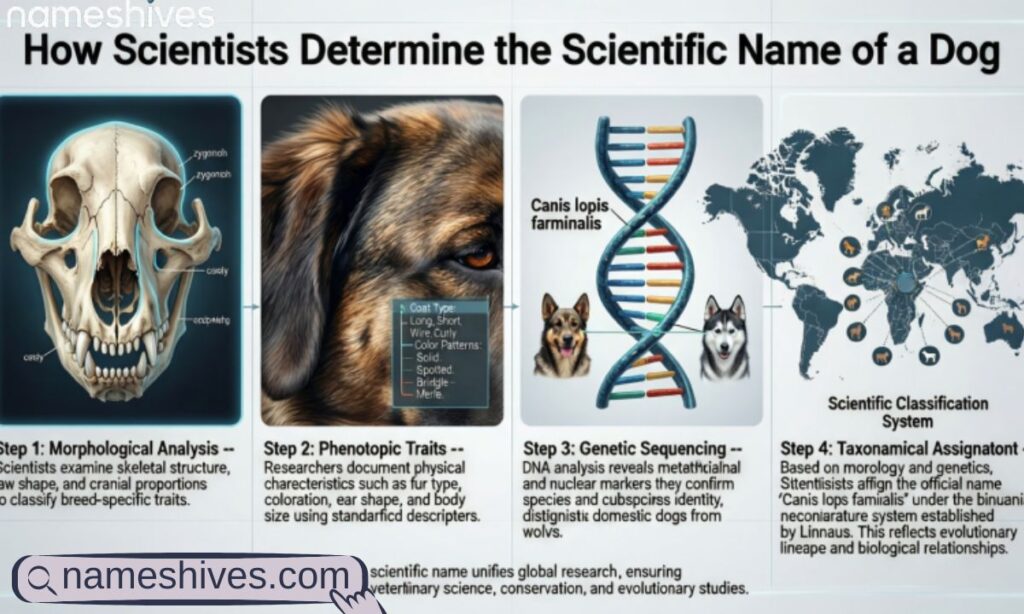
Scientists use a combination of morphological studies, genetic analysis, and historical taxonomy to determine and confirm scientific names. The classification of dogs has been debated, with some taxonomists previously considering them a separate species (Canis familiaris) before genetic evidence confirmed their subspecies status.
Modern DNA sequencing has been instrumental in establishing the close genetic relationship between dogs and gray wolves. Researchers examine skull structure, dental patterns, and skeletal features to understand evolutionary relationships.
The process involves comparing specimens, reviewing historical scientific literature, and following established nomenclature rules. International committees of taxonomists ultimately decide on official classifications, which can be revised as new evidence emerges from ongoing research.
Dog Taxonomy Compared With Other Canidae Species
The family Canidae includes approximately 34 species, ranging from foxes and jackals to wolves and wild dogs. Within this family, the genus Canis contains species like the gray wolf (Canis lupus), coyote (Canis latrans), and golden jackal (Canis aureus).
Dogs share their genus with these closely related species but are unique in their subspecies classification as familiaris. Other canids like fennec foxes and red foxes belong to different genera entirely, reflecting greater evolutionary distance.
The taxonomy reveals that dogs are more closely related to wolves and coyotes than they are to any fox species. Understanding these relationships helps scientists study evolution, behavior, and ecology across the entire dog family.
Extensively Identified Breeds and Their Origin
The Fédération Cynologique Internationale recognizes over 350 distinct dog breeds, each developed for specific purposes and environments. Ancient breeds like the Basenji from Central Africa and the Saluki from the Middle East date back thousands of years.
European breeds such as the German Shepherd and English Bulldog were developed more recently for herding and bull-baiting respectively. Asian breeds like the Shih Tzu and Akita have royal histories as companion and guardian dogs in their native regions.
Many modern breeds were established during the Victorian era when kennel clubs began formalizing breed standards. Each breed’s origin story reflects the human needs and cultural values of the regions where they were developed.
Classification of Dogs

- Kingdom: Animalia
- Phylum: Chordata
- Class: Mammalia
- Order: Carnivora
- Family: Canidae
- Genus: Canis
- Species: Canis lupus
- Subspecies: Canis lupus familiaris
- Domestic animal group
- Vertebrate classification
- Warm-blooded mammal
- Placental mammal
- Four-legged animal
- Carnivorous lineage
- Canine family group
- Mammal with fur
- Tail-bearing mammal
- Land-dwelling animal
- Social animal species
- Pack-living nature
- Intelligent mammal
- Long-snouted animal
- Sharp-toothed mammal
- Clawed mammal
- Carnivore order member
- Animal kingdom member
- Chordate organism
- Backbone-bearing animal
- Mammalian species
- Domesticated wolf
- Canis genus member
- Canidae family member
- Mammal classification level
- Biological taxonomy
- Scientific grouping
- Evolutionary lineage
- Genetic classification
- Zoological category
- Domestic species group
- Companion animal class
- Terrestrial mammal
eating - Meat- ancestry
- Canine taxonomy
- Dog biological identity
- Species classification
- Animal classification system
- Scientific hierarchy
- Domestic canine
- Mammal order Carnivora
- Dog taxonomic rank
Frequently Asked Questions
What is the scientific name of a dog?
The scientific name of a dog is Canis lupus familiaris, showing it is a subspecies of the gray wolf.
Why is the dog called Canis lupus familiaris?
Dogs share genetic roots with wolves, which is why scientists classify them under the wolf species.
Is the domestic dog a separate species?
No, dogs are considered a subspecies of the gray wolf, not a completely separate species.
How are dogs classified in animal taxonomy?
Dogs belong to the kingdom Animalia, class Mammalia, order Carnivora, and family Canidae.
What family does the dog belong to?
Dogs are part of the Canidae family, which also includes wolves, foxes, and jackals.
Are dogs related to wolves scientifically?
Yes, scientific studies show dogs evolved from ancient wolves thousands of years ago.
What genus does the dog fall under?
Dogs are classified under the genus Canis, which includes wolves and coyotes.
When was the scientific classification of dogs defined?
The modern classification developed as genetic research confirmed the close link between dogs and wolves.
Do all dog breeds share the same scientific name?
Yes, all dog breeds fall under Canis lupus familiaris, regardless of size or appearance.
Why is dog taxonomy important to understand?
It helps explain dog evolution, behavior, and their close biological connection to wild canines.
Conclusion
The scientific name of the dog helps us understand its true place in the animal world. Known as Canis lupus familiaris, it shows that dogs are closely related to wolves. This classification explains many shared traits like behavior, body structure, and instincts. Learning this makes the bond between dogs and nature clearer.
Dog taxonomy and classification also show how dogs fit into the larger family of mammals. From kingdom to species, each level tells a simple story of their evolution. This scientific system helps researchers, students, and pet lovers learn more about dogs. Overall, it deepens our respect for this loyal and well-known animal.

David Corner is a names expert with 4 years of experience in researching name meanings, origins, and cultural significance. He is currently working with Nameshives.com, where he contributes to creating insightful and meaningful name content for a global audience.
