

Monkeys are fascinating animals that live in forests, mountains, and many other habitats around the world. They are known for their intelligence, playful behavior, and strong social groups. Scientists study monkeys to understand their behavior, evolution, and relationship with humans. One important way scientists identify monkeys is by using scientific names and biological classification.
The scientific name of a monkey helps researchers clearly identify different species and avoid confusion between similar animals. Biological classification groups monkeys based on shared features such as body structure, diet, and genetics. This system helps scientists understand how monkeys are related to other animals, especially apes and humans. Learning about the scientific name and classification of monkeys also helps us appreciate their place in nature.
What is a Scientific Name?
A scientific name (also called a binomial nomenclature) is a two-part Latin name given to every living organism, introduced by Carl Linnaeus. It consists of:
- Genus (capitalized) + Species (lowercase) — e.g., Homo sapiens
Monkey’s Biological Classification
| Group | Region | Characteristics |
| New World Monkeys (Platyrrhini) | Americas | Flat noses, prehensile tails |
| Old World Monkeys (Cercopithecidae) | Africa & Asia | Narrow noses, non-prehensile tails |
Common Types of Monkeys & Their Scientific Names
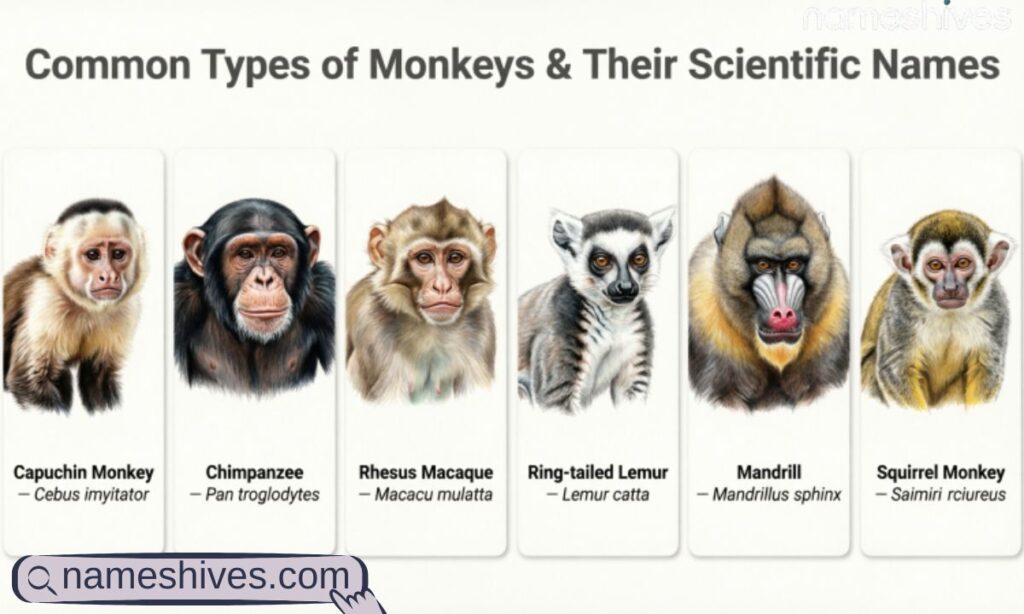
New World Monkeys
| Common Name | Scientific Name |
| Howler Monkey | Alouatta palliata |
| Spider Monkey | Ateles geoffroyi |
| Capuchin Monkey | Cebus capucinus |
| Squirrel Monkey | Saimiri sciureus |
| Marmoset | Callithrix jacchus |
| Tamarin | Saguinus oedipus |
Old World Monkeys
| Common Name | Scientific Name |
| Rhesus Macaque | Macaca mulatta |
| Baboon | Papio ursinus |
| Mandrill | Mandrillus sphinx |
| Proboscis Monkey | Nasalis larvatus |
| Golden Snub-nosed Monkey | Rhinopithecus roxellana |
| Vervet Monkey | Chlorocebus pygerythrus |
Full Biological Classification
| Rank | Classification |
| Kingdom | Animalia |
| Phylum | Chordata |
| Class | Mammalia |
| Order | Primates |
| Family | Cercopithecidae |
| Genus | Macaca |
| Species | Macaca mulatta |
What Do Monkeys Eat?
Primary Foods
| Food Category | Examples |
| Fruits | Bananas, figs, berries, mangoes (main diet) |
| Leaves & Plants | Young leaves, shoots, stems, flowers |
| Insects | Beetles, ants, grasshoppers (protein source) |
| Seeds & Nuts | Tree seeds, hard nuts cracked with tools |
| Eggs & Small Animals | Bird eggs, lizards, frogs (occasional) |
| Fungi & Bark | Tree bark, mushrooms, roots |
Social Harmony Among Monkeys
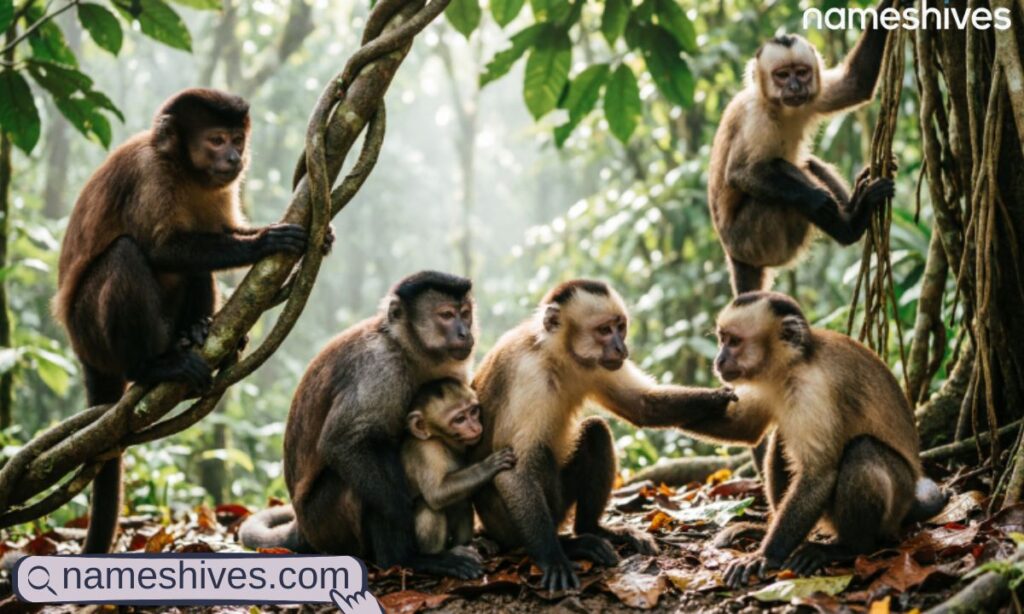
Monkeys are among the most socially complex animals on Earth. Their social life is rich, structured, and fascinating:
Social Structure
- Most monkeys live in groups called troops, bands, or cartloads
- Groups range from 5 to 200+ members depending on species
- Led by a dominant male or matriarch depending on species
How They Bond
| Behavior | Purpose |
| Grooming | Builds trust, removes parasites, strengthens bonds |
| Vocalizations | Warn of predators, communicate emotions |
| Play Fighting | Teaches young survival skills |
| Eye Contact & Gestures | Express dominance or submission |
| Hugging & Touching | Comfort during stress or conflict |
Hierarchy & Roles
- Alpha males protect the group and get priority access to food
- Females often form the stable core of the group
- Young males may leave to join or form new troops
- Alliances are formed to compete for rank — political behavior!
Did You Know? Vervet monkeys have specific alarm calls for different predators — one call for eagles, another for snakes, another for leopards!
Scientific Names of Monkeys
| Common Name | Scientific Name | Family |
| Howler Monkey | Alouatta palliata | Atelidae |
| Spider Monkey | Ateles geoffroyi | Atelidae |
| Capuchin Monkey | Cebus capucinus | Cebidae |
| Squirrel Monkey | Saimiri sciureus | Cebidae |
| Pygmy Marmoset | Cebuella pygmaea | Callitrichidae |
| Common Marmoset | Callithrix jacchus | Callitrichidae |
| Golden Lion Tamarin | Leontopithecus rosalia | Callitrichidae |
| Rhesus Macaque | Macaca mulatta | Cercopithecidae |
| Japanese Macaque | Macaca fuscata | Cercopithecidae |
| Mandrill | Mandrillus sphinx | Cercopithecidae |
| Baboon | Papio ursinus | Cercopithecidae |
| Gelada | Theropithecus gelada | Cercopithecidae |
| Proboscis Monkey | Nasalis larvatus | Cercopithecidae |
| Vervet Monkey | Chlorocebus pygerythrus | Cercopithecidae |
| Colobus Monkey | Colobus guereza | Cercopithecidae |
| Golden Snub-nosed | Rhinopithecus roxellana | Cercopithecidae |
Monkey Taxonomy
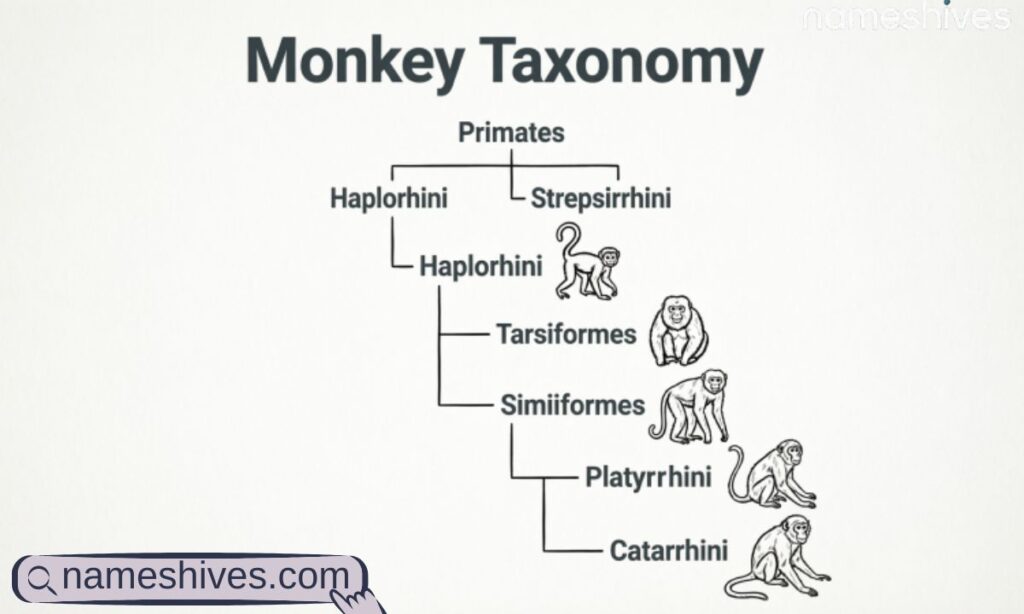
Taxonomy is the scientific system of classifying living organisms into hierarchical groups based on shared characteristics and evolutionary relationships. It was developed by Carl Linnaeus in the 18th century.
Characteristics of Monkey
| Feature | Description |
| Body Size | 4 inches (Pygmy Marmoset) to 3 feet (Mandrill) |
| Weight | 100g (Marmoset) to 35 kg (Mandrill) |
| Limbs | Four limbs, adapted for climbing & grasping |
| Hands & Feet | Five digits with flat nails (not claws) |
| Eyes | Forward-facing for depth perception & 3D vision |
| Tail | Most have tails (unlike apes); some prehensile |
| Fur/Coat | Varies widely — brown, black, golden, red, grey |
| Teeth | 32–36 teeth; adapted for varied diets |
| Brain | Large relative to body size; highly developed |
Frequently Asked Questions
What is the scientific name of a monkey?
The general scientific term for monkeys falls under the infraorder Simiiformes, but many species exist, each with its own scientific name.
How are monkeys classified in biological classification?
Monkeys belong to the order Primates, which also includes apes, lemurs, and humans in the animal kingdom.
What are the main groups of monkeys?
Monkeys are mainly divided into New World monkeys and Old World monkeys, based on where they live and their physical features.
What kingdom do monkeys belong to?
Monkeys belong to the Animalia kingdom because they are multicellular animals that can move and respond to their environment.
What is the phylum of monkeys in biology?
Monkeys are part of the Chordata phylum, meaning they have a spinal cord and a backbone.
What class do monkeys belong to?
Monkeys belong to the Mammalia class, which means they are warm-blooded animals that give birth to live young.
What is the order of monkeys in scientific classification?
The scientific order of monkeys is Primates, a group known for intelligence, flexible hands, and forward-facing eyes.
What is the difference between monkeys and apes in classification?
Monkeys usually have tails and belong to different families, while apes like gorillas and chimpanzees do not have tails.
Why are scientific names important for monkeys?
Scientific names help scientists identify and study monkey species clearly without confusion across different languages.
How many species of monkeys exist in the world?
Scientists have identified over 260 species of monkeys, living mainly in tropical forests around the world.
Conclusion
Monkeys are interesting animals that belong to the primate family. Their scientific classification helps scientists understand how they are related to other animals. By using scientific names, researchers around the world can easily study and share information about different monkey species. This system also helps organize animals based on their physical features and genetic similarities.
In conclusion, learning the scientific name and biological classification of monkeys gives us a deeper understanding of nature. It shows how monkeys are connected to other primates and living organisms. This knowledge also helps in wildlife research and conservation efforts. By studying classification, we can better appreciate the diversity and importance of monkeys in the natural world.

David Corner is a names expert with 4 years of experience in researching name meanings, origins, and cultural significance. He is currently working with Nameshives.com, where he contributes to creating insightful and meaningful name content for a global audience.
