

The cat’s scientific name is Felis catus, and it is used to identify domestic cats all around the world. This special name helps scientists clearly classify and study cats. While people simply say “cat,” the scientific name gives more exact information. It shows that cats belong to a specific group in the animal kingdom.
Felis catus is part of the cat family known as Felidae. Domestic cats are closely related to wild cats but have lived with humans for thousands of years. Their scientific name highlights their unique place in nature and science. Understanding this name helps us discover true details about these beloved pets.
What is the Scientific Name of the Cat?
The scientific name of the domestic cat is Felis catus, first formally described by the Swedish botanist and zoologist Carl Linnaeus in 1758 in his landmark publication Systema Naturae. Some taxonomists also recognize the name Felis silvestris catus, treating the domestic cat as a subspecies of the European wildcat. However, the name Felis catus remains the most widely accepted and used designation in modern biology and veterinary science.
The name breaks down simply into two parts following binomial nomenclature, the system used to classify all living organisms. Felis is the genus name referring to small cats, and catus is the species name derived from Latin meaning “clever” or “cunning.” Together, they form a unique identifier recognized by scientists across every language and country in the world.
History of The Cat Scientific Name

The history of the cat’s scientific name is deeply tied to the development of modern taxonomy. Before Linnaeus introduced his binomial system, animals were described using long, cumbersome Latin phrases that varied from one scientist to another, making communication between researchers extremely difficult.
In 1758, Carl Linnaeus published the 10th edition of Systema Naturae, which is considered the starting point of modern zoological nomenclature. In this work, he assigned the name Felis catus to the domestic cat. Linnaeus based his description on European domestic cats that had been living alongside humans for thousands of years.
However, the naming of cats did not stop there. In 1775, the German naturalist Johann Christian Polycarp Erxleben described the African wildcat as Felis lybica, which later became critical in understanding the domestic cat’s origins. For much of the 19th and 20th centuries, taxonomists debated whether domestic cats deserved their own species name or should be classified as a subspecies of the wildcat Felis silvestris.
Importance of the Scientific Name of the Cat
Scientific names serve a purpose far beyond academic formality. They are essential tools that make biological science precise, universal, and reliable. The name Felis catus carries enormous importance for several reasons.
First, it provides universal communication. A veterinarian in Pakistan, a zoologist in Brazil, and a geneticist in Japan all understand exactly which animal is being referred to when Felis catus is used, regardless of whether their local name for the cat is “billi,” “gato,” or “neko.” This eliminates dangerous misunderstandings in medicine, conservation, and research.
Second, the scientific name conveys evolutionary and taxonomic information. Placing the cat in the genus Felis immediately tells a scientist that it belongs to a group of small, typically non-roaring cats, distinguishing it from lions (Panthera leo) or cheetahs (Acinonyx jubatus).
Differences Between Domestic Cats and Wild Cats
Behavioral differences are among the most striking. Domestic cats have evolved to communicate extensively with humans, using vocalizations like meowing that adult wild cats rarely use with each other. Wild cats such as the African wildcat (Felis lybica) are solitary, intensely territorial, and largely nocturnal, while domestic cats have adapted to live in social groups and adjust their activity patterns to match human schedules.
Physical differences also exist, though they are subtle. Domestic cats tend to have slightly shorter legs, smaller brains relative to body size, and more varied coat colors and patterns compared to their wild counterparts, which typically display uniform striped or spotted coats for camouflage. The domestication process also resulted in cats having a more juvenile facial appearance, with rounder faces and larger eyes, a phenomenon known as neoteny.
Related Species in the Felidae Family

The family Felidae is one of the most fascinating in the animal kingdom, containing 37 recognized species of cats ranging from the tiny rusty-spotted cat to the massive lion. Felis catus sits within the genus Felis, which includes several closely related small wild cats.
The African Wildcat (Felis lybica) is the domestic cat’s closest relative and direct ancestor, native to Africa, the Middle East, and Central Asia. It is so genetically similar to domestic cats that the two can interbreed and produce fertile offspring.
The European Wildcat (Felis silvestris) is another close relative found across Europe and parts of Asia. Though similar in appearance to a large tabby cat, it is notably more muscular and temperamentally much more aggressive and untameable than domestic cats.
How Scientists Use the Cats Scientific Name in Research
In scientific research, Felis catus is far more than a label. It is a gateway to a vast body of literature, databases, and institutional knowledge that researchers rely on across multiple disciplines.
In genomics and genetics, scientists use the name Felis catus to search databases like NCBI GenBank and Ensembl, where the cat’s entire genome has been sequenced and catalogued. The domestic cat genome was first sequenced in 2007 and has been used to study genetic diseases, evolutionary biology, and even human health conditions, since cats naturally develop diseases like diabetes, hypertrophic cardiomyopathy, and certain cancers that closely mirror human versions of the same conditions.
In veterinary pharmacology, the species name is used to ensure that medications are tested and approved specifically for Felis catus, since cats have unique metabolic pathways. For example, cats lack certain liver enzymes that most mammals have, making them uniquely sensitive to drugs like acetaminophen and certain essential oils that are safe for other species.
Fun Facts About the Scientific Name for Cat
The word catus in Felis catus comes from Latin and is believed to mean “clever,” “cunning,” or “domestic cat,” making it one of the few scientific names that is essentially a compliment to the animal’s intelligence.
Carl Linnaeus, who named the cat in 1758, was himself reportedly not particularly fond of cats, making it somewhat ironic that he gave them one of the most widely recognized scientific names in the world.
The genus name Felis is the direct Latin word for cat and is also the root of the English word “feline,” meaning cat-like. This makes Felis catus essentially translate to “cat cat” in a loose sense, a delightfully redundant name.
Evolutionary Context: From Felis lybica to Felis catus
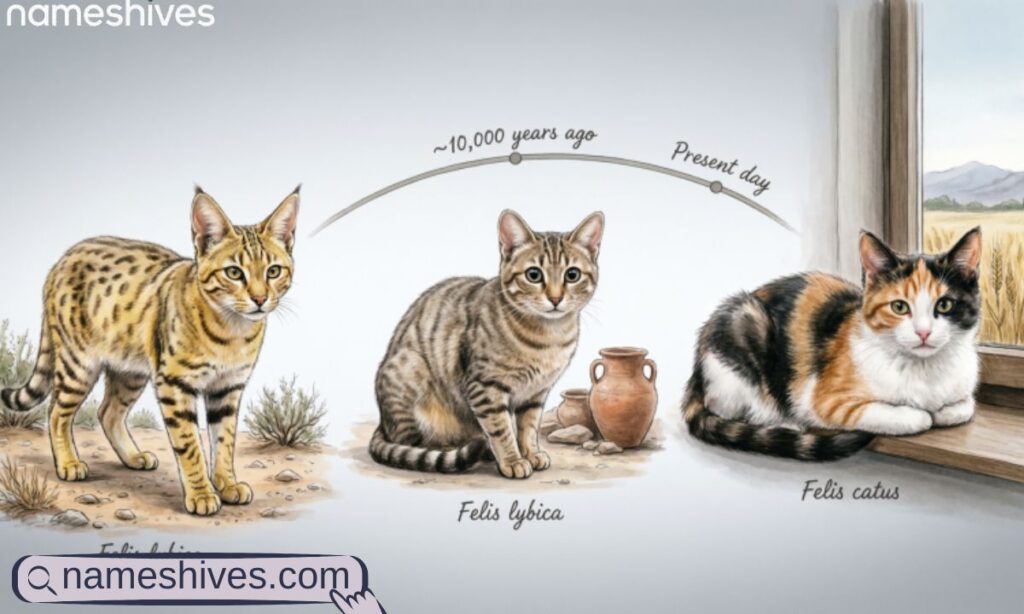
The evolutionary journey from the wild African cat to the domestic companion curled on your sofa is one of the most remarkable stories in the history of animal domestication, and it began not with deliberate human intervention but with a mutually beneficial relationship that developed naturally.
Genetic and archaeological evidence suggests that cat domestication began approximately 10,000 years ago in the Fertile Crescent, the region encompassing modern-day Middle East including parts of Turkey, Iraq, Syria, and Israel. This timing was no coincidence. It coincided precisely with the dawn of agriculture and the Neolithic Revolution, when humans first began storing grain in large quantities.
Taxonomy and Classification of the House Cat
Every living organism on Earth carries a place in a vast, carefully organized biological hierarchy. The house cat, one of the most familiar animals in human civilization, is no exception. Behind every purring companion resting on a windowsill lies a rich taxonomic story that connects it to ancient wildcats, fearsome lions, and the very origins of life on this planet.
Understanding the taxonomy and classification of the house cat, Felis cactus, is not merely an academic exercise. It is a journey through evolutionary history, biological relationships, and the scientific frameworks that help us make sense of the natural world.
| Taxonomic Rank | Classification | Meaning |
| Domain | Eukaryota | Organisms with a membrane-bound nucleus |
| Kingdom | Animalia | Multicellular heterotrophic organisms |
| Phylum | Chordata | Animals with a notochord or backbone |
| Class | Mammalia | Warm-blooded animals that nurse young with milk |
| Order | Carnivora | Primarily meat-eating mammals |
| Family | Felidae | All cats, wild and domestic |
| Genus | Felis | Small cats that cannot roar |
| Species | Felis catus | The domestic house cat |
Frequently Asked Questions
What is the scientific name of a domestic cat?
The scientific name of a domestic cat is Felis catus. It is the official biological name used by scientists worldwide.
Why is the cat called Felis catus?
The name comes from Latin, where Felis means cat and catus refers to a domesticated or tamed animal.
Are Felis catus and Felis silvestris the same?
They are closely related, but Felis silvestris usually refers to wildcats, while Felis catus is the domesticated species.
Who gave cats the scientific name Felis catus?
The classification was formally described by the famous scientist Carl Linnaeus in the 18th century.
What family does Felis catus belong to?
Domestic cats belong to the family Felidae, which also includes lions, tigers, and other wild cats.
Is the scientific name Felis catus used everywhere?
Yes, scientists around the world use Felis catus as the universal scientific name for domestic cats.
Why are scientific names important for animals like cats?
Scientific names help avoid confusion because common names can differ between languages and regions.
Can house cats and wild cats breed together?
In some cases, domestic cats can breed with certain wildcat species because they share similar genetics.
How long have Felis catus lived with humans?
Domestic cats have lived alongside humans for about 9,000 years, mainly helping control pests like rodents.
What makes Felis catus different from other animals?
Cats are known for their agility, sharp senses, retractable claws, and strong hunting instincts, even as pets.
Conclusion
The cat’s scientific name is Felis catus, and it helps us understand our beloved pets in a more scientific way. This name shows that cats belong to the animal kingdom and are part of the feline family. While we see them as cute and playful companions, science sees them as a unique species with special traits. Learning their scientific name connects everyday life with biology. It also reminds us that house cats share roots with wild cats.
In conclusion, knowing that the cat’s scientific name is Felis catus gives us a deeper appreciation for these gentle animals. It highlights their history, behavior, and place in nature. From ancient times to modern homes, cats have stayed close to humans. Understanding their true details makes us respect them even more. Cats are not just pets—they are fascinating creatures with a strong scientific identity.

David Corner is a names expert with 4 years of experience in researching name meanings, origins, and cultural significance. He is currently working with Nameshives.com, where he contributes to creating insightful and meaningful name content for a global audience.
