

Foxes are fascinating animals known for their intelligence, sharp senses, and beautiful fur. Many people only recognize the common red fox, but there are actually many different types found around the world. Each species has its own unique features, habitat, and behavior that make it special. Learning their scientific names helps us understand how scientists classify and study them.
In this guide, you will discover the scientific name of foxes along with a list of 50 different types. This information makes it easier to see how fox species are related to each other in the animal kingdom. It is also helpful for students, animal lovers, and anyone curious about wildlife. By exploring these names, you can gain a deeper appreciation for the diversity of foxes on Earth.
What Is the Fox Scientific Name?
Foxes belong to the family Canidae (the dog family). The most well-known and widespread fox — the red fox — carries the scientific name Vulpes vulpes. However, “fox” is not a single taxonomic group but rather a general term applied to several genera within Canidae, including Vulpes, Urocyon, Lycalopex, and others.
Pronunciation of Fox Scientific Names
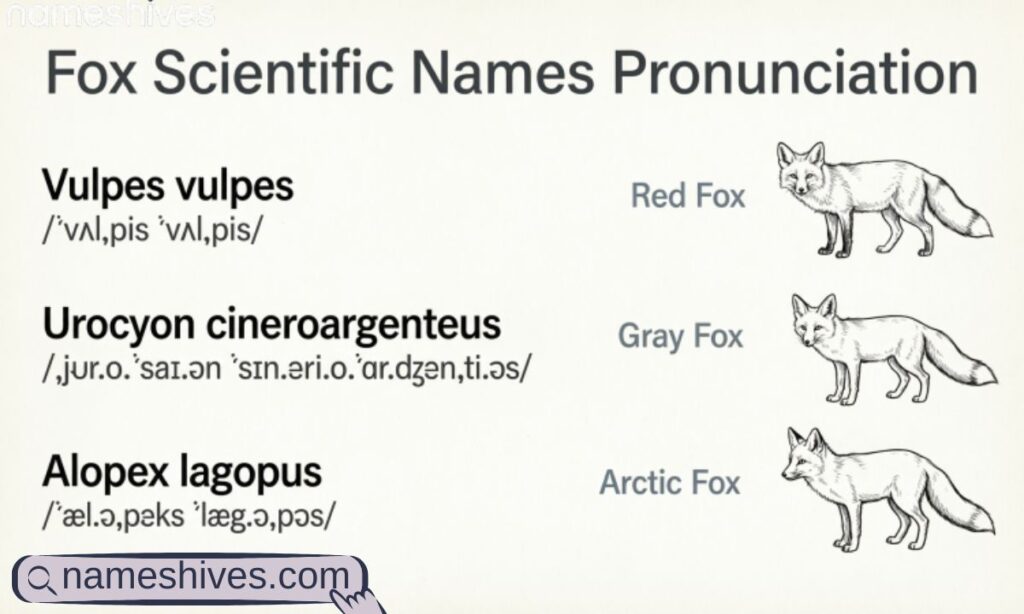
- Vulpes vulpes — VUL-peez VUL-peez
- Urocyon cinereoargenteus — YOO-roh-sy-on sin-eer-ee-oh-ar-JEN-tee-us
- Lycalopex culpaeus — ly-KAL-oh-peks kul-PAY-us
- Otocyon megalotis — oh-TOH-sy-on meg-uh-LOH-tis
- Cerdocyon thous — SER-doh-sy-on THOOS
Meaning of Fox Scientific Names
- Vulpes — Latin for “fox”
- Urocyon — from Greek oura (tail) + kyon (dog), meaning “tailed dog”
- Lycalopex — from Greek lykos (wolf) + alopex (fox), meaning “wolf-fox”
- Otocyon — from Greek otos (ear) + kyon (dog), meaning “ear dog” — a nod to its enormous ears
- Cerdocyon — from Greek kerdos (cunning) + kyon (dog), meaning “cunning dog”
Classification of Fox
| Rank | Classification |
| Kingdom | Animalia |
| Phylum | Chordata |
| Class | Mammalia |
| Order | Carnivora |
| Family | Canidae |
| Genera | Vulpes, Urocyon, Lycalopex, Otocyon, Cerdocyon, others |
List of 50 Fox Species and Their Scientific Names
(Note: Taxonomists recognize roughly 37 true fox species; the list below includes all widely recognized species plus close fox-like canids)
| Common Name | Scientific Name | |
| 1 | Red Fox | Vulpes vulpes |
| 2 | Arctic Fox | Vulpes lagopus |
| 3 | Fennec Fox | Vulpes zerda |
| 4 | Kit Fox | Vulpes macrotis |
| 5 | Swift Fox | Vulpes velox |
| 6 | Pale Fox | Vulpes pallida |
| 7 | Rüppell’s Fox | Vulpes rueppelli |
| 8 | Cape Fox | Vulpes chama |
| 9 | Corsac Fox | Vulpes corsac |
| 10 | Tibetan Sand Fox | Vulpes ferrilata |
| 11 | Blanford’s Fox | Vulpes cana |
| 12 | Indian Fox | Vulpes bengalensis |
| 13 | Afghan Fox | Vulpes cana |
| 14 | Turkestan Fox | Vulpes ferrilata |
| 15 | Bengal Fox | Vulpes bengalensis |
| 16 | Sand Fox | Vulpes rueppelli |
| 17 | Arabian Fox | Vulpes arabica |
| 18 | Ethiopian Dwarf Fox | Vulpes simensis |
| 19 | Simien Fox / Ethiopian Wolf | Canis simensis |
| 20 | Gray Fox | Urocyon cinereoargenteus |
| 21 | Island Fox | Urocyon littoralis |
| 22 | Culpeo (Andean Fox) | Lycalopex culpaeus |
| 23 | South American Gray Fox | Lycalopex griseus |
| 24 | Pampas Fox | Lycalopex gymnocercus |
| 25 | Sechuran Fox | Lycalopex sechurae |
| 26 | Hoary Fox | Lycalopex vetulus |
| 27 | Darwin’s Fox | Lycalopex fulvipes |
| 28 | Crab-Eating Fox | Cerdocyon thous |
| 29 | Bat-Eared Fox | Otocyon megalotis |
| 30 | Maned Wolf (fox-like) | Chrysocyon brachyurus |
| 31 | Short-Eared Dog | Atelocynus microtis |
| 32 | Bush Dog | Speothos venaticus |
| 33 | Blandford’s Fox | Vulpes cana |
| 34 | Cross Fox (Red Fox variant) | Vulpes vulpes |
| 35 | Silver Fox (Red Fox variant) | Vulpes vulpes |
| 36 | Japanese Red Fox | Vulpes vulpes japonica |
| 37 | European Red Fox | Vulpes vulpes crucigera |
| 38 | North American Red Fox | Vulpes vulpes fulva |
| 39 | Montane Fox | Lycalopex culpaeus andinus |
| 40 | Patagonian Fox | Lycalopex griseus |
| 41 | Chilean Fox | Lycalopex fulvipes |
| 42 | Peruvian Fox | Lycalopex sechurae |
| 43 | Eastern Gray Fox | Urocyon cinereoargenteus |
| 44 | San Nicolas Island Fox | Urocyon littoralis dickeyi |
| 45 | Santa Cruz Island Fox | Urocyon littoralis santacruzae |
| 46 | Santa Rosa Island Fox | Urocyon littoralis santarosae |
| 47 | San Clemente Island Fox | Urocyon littoralis clementae |
| 48 | Catalina Island Fox | Urocyon littoralis catalinae |
| 49 | San Miguel Island Fox | Urocyon littoralis littoralis |
| 50 | Saharan Fox | Vulpes zerda (Fennec) |
Interesting Facts About Foxes
Incredible diversity. Foxes are found on every continent except Antarctica, thriving in deserts, tundra, forests, grasslands, and even cities.
Not a single group. The word “fox” is informal — true foxes belong to the genus Vulpes, but many animals called foxes (gray fox, South American foxes) belong to entirely different genera.
Fennec fox ears are legendary. The fennec fox (Vulpes zerda) has ears up to 6 inches long — proportionally the largest ears of any carnivore — used to dissipate heat and detect underground prey.
Famous Fox Scientific Names You Should Know
- Vulpes vulpes – Red Fox
- Vulpes zerda – Fennec Fox
- Vulpes lagopus – Arctic Fox
- Vulpes macrotis – Kit Fox
- Vulpes velox – Swift Fox
- Urocyon cinereoargenteus – Gray Fox
- Lycalopex culpaeus – Culpeo Fox
- Otocyon megalotis – Bat-Eared Fox
- Cerdocyon thous – Crab-Eating Fox
- Vulpes bengalensis – Indian Fox
- Vulpes chama – Cape Fox
- Vulpes corsac – Corsac Fox
- Lycalopex gymnocercus – Pampas Fox
- Vulpes rueppelli – Rüppell’s Fox
- Lycalopex griseus – South American Gray Fox
- Vulpes pallida – Pale Fox
- Lycalopex fulvipes – Darwin’s Fox
- Urocyon littoralis – Island Fox
- Vulpes ferrilata – Tibetan Sand Fox
- Vulpes cana – Blanford’s Fox
- Lycalopex sechurae – Sechuran Fox
- Lycalopex vetulus – Hoary Fox
- Vulpes vulpes fulva – North American Red Fox
- Vulpes vulpes japonica – Japanese Red Fox
- Vulpes vulpes crucigera – European Red Fox
- Chrysocyon brachyurus – Maned Wolf (fox-like)
- Vulpes vulpes pusilla – Desert Red Fox
- Atelocynus microtis – Short-Eared Dog Fox
- Vulpes pallida pallida – Nominate Pale Fox
- Vulpes rueppelli caesia – Syrian Rüppell’s Fox
- Vulpes macrotis mutica – San Joaquin Kit Fox
- Vulpes velox hebes – Northern Swift Fox
- Vulpes zerda zerda – Nominate Fennec Fox
- Vulpes lagopus lagopus – Nominate Arctic Fox
- Urocyon cinereoargenteus cinereoargenteus – Eastern Gray Fox
- Vulpes bengalensis bengalensis – Nominate Indian Fox
- Otocyon megalotis megalotis – Southern Bat-Eared Fox
- Lycalopex culpaeus culpaeus – Nominate Culpeo
- Lycalopex griseus griseus – Nominate South American Gray Fox
- Cerdocyon thous aquilis – Northern Crab-Eating Fox
- Vulpes chama chama – Nominate Cape Fox
- Vulpes corsac corsac – Nominate Corsac Fox
- Lycalopex gymnocercus gymnocercus – Nominate Pampas Fox
- Vulpes ferrilata ferrilata – Nominate Tibetan Sand Fox
- Vulpes cana cana – Nominate Blanford’s Fox
- Lycalopex sechurae sechurae – Nominate Sechuran Fox
- Lycalopex vetulus vetulus – Nominate Hoary Fox
- Lycalopex fulvipes fulvipes – Nominate Darwin’s Fox
- Urocyon littoralis littoralis – San Miguel Island Fox
- Vulpes rueppelli sabaea – Arabian Rüppell’s Fox
Unique Fox Scientific Names for Every Species
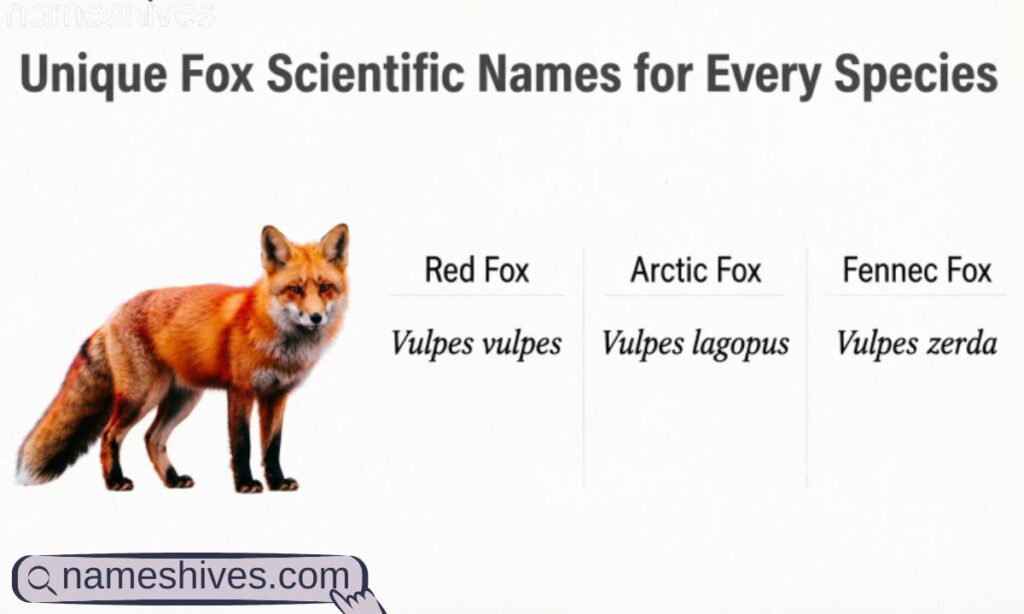
- Vulpes arabica – Arabian Fox
- Vulpes pallida edwardsi – Edwards’ Pale Fox
- Vulpes corsac kalmykorum – Kalmyk Corsac Fox
- Vulpes ferrilata ekloni – Eklon’s Tibetan Fox
- Vulpes macrotis arsipus – Desert Kit Fox
- Vulpes velox velox – Plains Swift Fox
- Urocyon littoralis dickeyi – San Nicolas Island Fox
- Urocyon littoralis santacruzae – Santa Cruz Island Fox
- Urocyon littoralis santarosae – Santa Rosa Island Fox
- Urocyon littoralis clementae – San Clemente Island Fox
- Urocyon littoralis catalinae – Catalina Island Fox
- Lycalopex culpaeus andinus – Andean Culpeo Fox
- Lycalopex culpaeus reissii – Ecuador Culpeo Fox
- Lycalopex culpaeus lycoides – Patagonian Culpeo Fox
- Lycalopex griseus fulvipes – Chiloe Gray Fox
- Lycalopex gymnocercus antiquus – Ancient Pampas Fox
- Lycalopex sechurae tumescentis – Coastal Sechuran Fox
- Vulpes bengalensis fusca – Mountain Indian Fox
- Vulpes chama insolens – Kalahari Cape Fox
- Vulpes corsac turkmenicus – Turkmen Corsac Fox
- Otocyon megalotis virgatus – East African Bat-Eared Fox
- Cerdocyon thous entrerianus – Southern Crab-Eating Fox
- Cerdocyon thous germanus – Colombian Crab-Eating Fox
- Vulpes pallida cyrenaica – Libyan Pale Fox
- Vulpes rueppelli zarudnyi – Persian Rüppell’s Fox
- Vulpes zerda margarita – Sand Fennec Fox
- Vulpes lagopus beringensis – Bering Arctic Fox
- Vulpes lagopus fuliginosus – Icelandic Arctic Fox
- Vulpes lagopus hallensis – Hall Island Arctic Fox
- Vulpes vulpes harterti – Algerian Red Fox
- Vulpes vulpes montana – Mountain Red Fox
- Vulpes vulpes hoole – Himalayan Red Fox
- Vulpes vulpes griffithi – Afghan Red Fox
- Vulpes vulpes flavescens – Iranian Red Fox
- Vulpes vulpes karagan – Steppe Red Fox
- Vulpes vulpes ochroxantha – Himalayan Steppe Fox
- Vulpes vulpes silacea – Iberian Red Fox
- Vulpes vulpes splendidissima – Sakhalin Red Fox
- Vulpes vulpes tobolica – Siberian Red Fox
- Vulpes vulpes waddelli – Tibetan Red Fox
- Vulpes vulpes jakutensis – Yakut Red Fox
- Vulpes vulpes kenaiensis – Kenai Red Fox
- Vulpes vulpes necator – Sierra Nevada Red Fox
- Vulpes vulpes regalis – Great Plains Red Fox
- Vulpes vulpes cascadensis – Cascade Red Fox
- Vulpes lagopus semenovi – Semenov’s Arctic Fox
- Vulpes lagopus spitzbergenensis – Svalbard Arctic Fox
- Vulpes macrotis nevadensis – Nevada Kit Fox
- Vulpes macrotis tularensis – Tulare Kit Fox
- Vulpes macrotis devia – Baja Kit Fox
Common Fox Scientific Names and Their Origins
- Vulpes vulpes – Latin: “fox fox,” the doubled name emphasizing its quintessential fox nature
- Vulpes zerda – Arabic zerd meaning “yellow,” referencing the fennec’s sandy coat
- Vulpes lagopus – Greek: lagos (hare) + pous (foot), “hare-footed,” for its furry paws
- Vulpes macrotis – Greek: makros (large) + otis (ear), “big-eared fox”
- Vulpes velox – Latin: velox meaning “swift” or “fast”
- Vulpes bengalensis – Named after Bengal, India, its native homeland
- Vulpes chama – Derived from the Khoikhoi word for the Cape Fox
- Vulpes corsac – From the Turkic word karsak, meaning a type of steppe fox
- Vulpes pallida – Latin: pallida meaning “pale” or “wan,” for its light coat
- Vulpes rueppelli – Named after German naturalist Eduard Rüppell (1794–1884)
- Vulpes ferrilata – Latin: ferrum (iron) + lata (broad), “broad iron-colored,” for its gray coat
- Vulpes cana – Latin: cana meaning “white-haired” or “gray”
- Otocyon megalotis – Greek: otos (ear) + kyon (dog) + megas (great) + otis (ear), “great-eared ear-dog”
- Urocyon cinereoargenteus – Latin: cinereo (ash-gray) + argenteus (silver), “ash-silver tailed dog”
- Lycalopex culpaeus – Greek lykos (wolf) + alopex (fox); culpaeus from Latin culpa (fault), named after the “guilty” fox that raided chickens
- Lycalopex griseus – Latin: griseus meaning “gray”
- Lycalopex gymnocercus – Greek: gymnos (naked) + kerkos (tail), “naked-tailed fox”
- Lycalopex fulvipes – Latin: fulvus (tawny) + pes (foot), “tawny-footed fox”
- Lycalopex vetulus – Latin: vetulus meaning “old little one” or “oldish”
- Lycalopex sechurae – Named after the Sechura Desert of Peru
- Cerdocyon thous – Greek: kerdos (cunning) + kyon (dog); thous from Greek for “jackal”
- Chrysocyon brachyurus – Greek: chrysos (gold) + kyon (dog) + brachys (short) + oura (tail), “short-tailed golden dog”
- Urocyon littoralis – Latin: littoralis meaning “of the seashore,” for its island habitats
- Atelocynus microtis – Greek: ateles (incomplete) + kyon (dog) + mikros (small) + otis (ear), “small-eared incomplete dog”
- Vulpes arabica – Latin: arabica meaning “of Arabia,” its native range
- Speothos venaticus – Greek: speos (cave) + thous (jackal); Latin venaticus (of the hunt)
- Vulpes pallida edwardsi – Named after zoologist Alphonse Milne-Edwards
- Vulpes vulpes fulva – Latin: fulva meaning “tawny” or “reddish-yellow”
- Vulpes vulpes crucigera – Latin: crucigera meaning “cross-bearing,” for the cross pattern on its back
- Vulpes vulpes japonica – Latin: japonica meaning “of Japan”
- Vulpes lagopus fuliginosus – Latin: fuliginosus meaning “sooty,” for its dark coat
- Vulpes zerda zerda – Doubly emphasizing its Arabic color-name origin
- Vulpes macrotis mutica – Latin: mutica meaning “without a point,” referring to its blunter ear tips
- Otocyon megalotis virgatus – Latin: virgatus meaning “striped” or “rod-like”
- Vulpes vulpes harterti – Named after German ornithologist Ernst Hartert
- Lycalopex culpaeus andinus – Latin: andinus meaning “of the Andes”
- Vulpes corsac turkmenicus – Named after Turkmenistan, part of its range
- Vulpes lagopus spitzbergenensis – Named after Spitsbergen (Svalbard), Norway
- Vulpes vulpes montana – Latin: montana meaning “of the mountains”
- Cerdocyon thous entrerianus – Named after Entre Ríos Province, Argentina
- Vulpes vulpes necator – Latin: necator meaning “killer,” for its predatory behavior
- Vulpes bengalensis fusca – Latin: fusca meaning “dark brown” or “dusky”
- Vulpes rueppelli sabaea – Named after the ancient kingdom of Saba (Sheba), Yemen
- Vulpes chama insolens – Latin: insolens meaning “unusual” or “uncommon”
- Vulpes lagopus beringensis – Named after the Bering Sea region
- Vulpes vulpes waddelli – Named after British officer L.A. Waddell
- Vulpes corsac kalmykorum – Named after the Kalmyk people of Central Asia
- Lycalopex griseus fulvipes – Combined meaning: “gray wolf-fox with tawny feet”
- Vulpes vulpes splendidissima – Latin superlative: “the most splendid fox”
- Vulpes macrotis arsipus – Greek: arsi (lifted) + pous (foot), “light-footed fox”
Rare Fox Scientific Names with Fascinating Meanings
- Vulpes vulpes hoole – Named after zoologist W. Hoole, little-known outside taxonomy
- Vulpes vulpes jakutensis – From Yakutia (Sakha Republic), one of the coldest fox habitats on Earth
- Vulpes vulpes kenaiensis – Named after the Kenai Peninsula, Alaska
- Vulpes vulpes cascadensis – From the Cascade Mountain Range; this subspecies may be distinct enough for full species status
- Vulpes vulpes regalis – Latin: regalis meaning “royal” — the most regal-sounding of all fox names
- Vulpes vulpes tobolica – Named after the Tobol River of western Siberia
- Vulpes vulpes ochroxantha – Greek: ochros (yellow) + xanthos (golden), “yellow-golden fox”
- Vulpes vulpes silacea – Latin: silaceus meaning “ochre-colored,” like siliceous clay
- Vulpes vulpes karagan – From Kazakh qara (black) + qan (blood), “black-blooded,” an ancient steppe name
- Vulpes vulpes flavescens – Latin: flavescens meaning “becoming yellow,” for its pale, fading coat
- Vulpes vulpes griffithi – Named after Edward Griffith, 19th-century British zoologist
- Vulpes lagopus hallensis – Named after Hall Island in the Bering Sea
- Vulpes lagopus semenovi – Named after Russian explorer Pyotr Semyonov-Tyan-Shansky
- Vulpes macrotis nevadensis – Named after Nevada; this population is now largely absorbed into the nominate
- Vulpes macrotis tularensis – Named after Tulare County, California; critically endangered
- Vulpes macrotis devia – Latin: devia meaning “deviant” or “off the beaten path,” for its remote Baja range
- Vulpes pallida cyrenaica – Named after the ancient Greek region of Cyrenaica (Libya)
- Vulpes rueppelli zarudnyi – Named after Russian zoologist Nikolai Zarudny
- Vulpes rueppelli caesia – Latin: caesia meaning “blue-gray,” for its unusual coat tone
- Vulpes ferrilata ekloni – Named after Russian naturalist Karl Eklon
- Urocyon littoralis dickeyi – Named after ornithologist Donald Dickey
- Urocyon littoralis clementae – Named after San Clemente Island, a U.S. Navy-controlled island
- Urocyon littoralis catalinae – Named after Santa Catalina Island, made famous by tourism
- Lycalopex culpaeus reissii – Named after German naturalist Eduard Reiss
- Lycalopex culpaeus lycoides – Greek: lykos (wolf) + eidos (resemblance), “wolf-resembling culpeo”
- Lycalopex gymnocercus antiquus – Latin: antiquus meaning “ancient,” a prehistoric-referenced subspecies
- Lycalopex sechurae tumescentis – Latin: tumescentis meaning “swelling” — referring to geographic coastal dune territory
- Cerdocyon thous germanus – Latin: germanus meaning “genuine” or “true-born,” referencing a purer population
- Cerdocyon thous aquilis – Latin: aquilis meaning “eagle-like,” an unusual descriptor possibly referencing sharp features
- Vulpes zerda margarita – Latin: margarita meaning “pearl” — a poetically beautiful name for the desert fennec
- Vulpes bengalensis fusca – Doubly rare: a subspecies of a species already underrepresented in literature
- Vulpes chama insolens – One of the rarest named Cape Fox subspecies, found in the Namib edge
- Otocyon megalotis virgatus – East African subspecies; virgatus (striped) refers to subtle facial markings
- Vulpes corsac kalmykorum – Named for the Kalmyk nomads who coexisted with this fox for centuries
- Lycalopex fulvipes fulvipes – Darwin himself collected the type specimen in 1834 on Chiloé Island
- Vulpes vulpes pusilla – Latin: pusilla meaning “very small” — the smallest red fox subspecies
- Vulpes vulpes waddelli – Collected at high altitude in Tibet; one of the most geographically extreme red fox forms
- Vulpes lagopus fuliginosus – The Icelandic arctic fox, the only native land mammal of Iceland
- Vulpes corsac turkmenicus – Found across the Karakum Desert; rarely studied due to remote habitat
- Vulpes arabica – So rare it was long considered a variant of Rüppell’s fox before gaining species status
- Vulpes vulpes harterti – The North African red fox; its taxonomic validity has been debated for over a century
- Vulpes macrotis mutica – The San Joaquin kit fox; one of the most endangered fox taxa in the United States
- Vulpes vulpes montana – The mountain red fox of Central Asia; adapted to altitudes above 3,000 meters
- Lycalopex culpaeus andinus – Found above 4,000 meters in the Andes; rarely photographed in its true range
- Vulpes rueppelli sabaea – The Yemeni Rüppell’s fox; one of the least-studied canids in the world
- Cerdocyon thous entrerianus – A southern form of the crab-eating fox with subtle dental differences that intrigue taxonomists
- Vulpes vulpes splendidissima – The Sakhalin red fox; named most splendid for its exceptionally thick, lustrous fur
- Vulpes vulpes necator – Latin for “killer”; historically persecuted by farmers across the Sierra Nevada
- Lycalopex vetulus vetulus – The hoary fox of Brazil; vetulus (little old one) evokes its grizzled, ancient appearance
- Vulpes cana cana – Blanford’s fox; found on sheer cliffs in the Middle East, capable of leaping between vertical rock faces with remarkable agility
Good Fox Scientific Names for Research and Study

These names are ideal for academic papers, field guides, taxonomic databases, and wildlife research projects.
| Common Name | Scientific Name | |
| 1 | Red Fox | Vulpes vulpes |
| 2 | Arctic Fox | Vulpes lagopus |
| 3 | Fennec Fox | Vulpes zerda |
| 4 | Kit Fox | Vulpes macrotis |
| 5 | Swift Fox | Vulpes velox |
| 6 | Pale Fox | Vulpes pallida |
| 7 | Rüppell’s Fox | Vulpes rueppellii |
| 8 | Cape Fox | Vulpes chama |
| 9 | Corsac Fox | Vulpes corsac |
| 10 | Tibetan Sand Fox | Vulpes ferrilata |
| 11 | Blanford’s Fox | Vulpes cana |
| 12 | Indian Fox | Vulpes bengalensis |
| 13 | Arabian Fox | Vulpes arabica |
| 14 | Gray Fox | Urocyon cinereoargenteus |
| 15 | Island Fox | Urocyon littoralis |
| 16 | Culpeo | Lycalopex culpaeus |
| 17 | South American Gray Fox | Lycalopex griseus |
| 18 | Pampas Fox | Lycalopex gymnocercus |
| 19 | Sechuran Fox | Lycalopex sechurae |
| 20 | Hoary Fox | Lycalopex vetulus |
| 21 | Darwin’s Fox | Lycalopex fulvipes |
| 22 | Crab-Eating Fox | Cerdocyon thous |
| 23 | Bat-Eared Fox | Otocyon megalotis |
| 24 | Maned Wolf | Chrysocyon brachyurus |
| 25 | Short-Eared Dog | Atelocynus microtis |
| 26 | Bush Dog | Speothos venaticus |
| 27 | Ethiopian Wolf | Canis simensis |
| 28 | African Wild Dog | Lycaon pictus |
| 29 | Dhole | Cuon alpinus |
| 30 | Side-Striped Jackal | Canis adustus |
| 31 | Black-Backed Jackal | Canis mesomelas |
| 32 | Golden Jackal | Canis aureus |
| 33 | San Nicolas Island Fox | Urocyon littoralis dickeyi |
| 34 | Santa Cruz Island Fox | Urocyon littoralis santacruzae |
Red Fox Scientific Name and Its Significance
The red fox (Vulpes vulpes) is the most studied fox species in the world. Below are 33 scientifically significant names covering its subspecies, regional variants, and closely related species used frequently in red fox research.
| Common Name | Scientific Name | Research Significance | |
| 35 | Red Fox (nominate) | Vulpes vulpes vulpes | Baseline reference subspecies for all red fox studies |
| 36 | North American Red Fox | Vulpes vulpes fulva | Studied extensively for rabies ecology |
| 37 | Japanese Red Fox | Vulpes vulpes japonica | Key in East Asian wildlife ecology research |
| 38 | European Red Fox | Vulpes vulpes crucigera | Most referenced in UK urban fox studies |
| 39 | Cascade Mountains Red Fox | Vulpes vulpes cascadensis | Conservation concern in Pacific Northwest |
| 40 | Sierra Nevada Red Fox | Vulpes vulpes necator | Critically rare; subject of endangered species studies |
| 41 | Cross Fox (color morph) | Vulpes vulpes | Studied in genetics and pelage variation |
| 42 | Silver Fox (color morph) | Vulpes vulpes | Famous Russian domestication experiment subject |
| 43 | Arctic Red Fox | Vulpes vulpes | Studied for range overlap with Arctic fox |
| 44 | Indian Red Fox | Vulpes vulpes griffithi | Studied in human-wildlife conflict research |
| 45 | Afghan Red Fox | Vulpes vulpes flavescens | Regional taxonomic significance |
| 46 | Beringian Red Fox | Vulpes vulpes beringiana | Ancient migration and Pleistocene studies |
| 47 | Alaskan Red Fox | Vulpes vulpes alascensis | Studied for permafrost habitat behavior |
| 48 | Egyptian Red Fox | Vulpes vulpes aegyptiacus | Desert adaptation studies |
| 49 | Tibetan Red Fox | Vulpes vulpes waddelli | High-altitude physiology research |
| 50 | Manchurian Red Fox | Vulpes vulpes manchurica | East Asian biodiversity assessment |
| 51 | Fennec Fox | Vulpes zerda | Closest relative for comparative anatomy |
| 52 | Pale Fox | Vulpes pallida | Studied alongside red fox in Sahel ecology |
| 53 | Cape Fox | Vulpes chama | Compared in Southern African canid studies |
| 54 | Corsac Fox | Vulpes corsac | Steppe ecosystem comparison with red fox |
| 55 | Swift Fox | Vulpes velox | Reintroduction program paired with red fox ecology |
| 56 | Kit Fox | Vulpes macrotis | Interbreeding with swift fox studied |
| 57 | Rüppell’s Fox | Vulpes rueppellii | Desert-range overlap with red fox studied |
| 58 | Blanford’s Fox | Vulpes cana | Compared for cliff-climbing behavior |
| 59 | Indian Fox | Vulpes bengalensis | Competition with red fox in Indian subcontinent |
| 60 | Tibetan Sand Fox | Vulpes ferrilata | Elevation niche studies |
| 61 | Vulpes alopecoides (extinct) | Vulpes alopecoides | Fossil ancestor relevant to red fox evolution |
| 62 | Vulpes riffautae (extinct) | Vulpes riffautae | Early Miocene relative for phylogeny studies |
| 63 | Vulpes praeglacialis (extinct) | Vulpes praeglacialis | Pleistocene ancestor of modern red fox |
| 64 | Vulpes qiuzhudingi (extinct) | Vulpes qiuzhudingi | Tibetan Plateau origin theory for Vulpes |
| 65 | Arabian Fox | Vulpes arabica | Disputed subspecies vs. red fox; taxonomic studies |
| 66 | Gray Fox | Urocyon cinereoargenteus | Outgroup comparison in red fox behavioral studies |
| 67 | Crab-Eating Fox | Cerdocyon thous | Used as evolutionary outgroup |
Arctic Fox Scientific Name and Adaptations
The Arctic fox (Vulpes lagopus) is one of the most physiologically remarkable mammals on Earth. These 33 names span its subspecies, close ecological relatives, and species used in comparative adaptation studies.
| Common Name | Scientific Name | Adaptation Relevance | |
| 68 | Arctic Fox (nominate) | Vulpes lagopus lagopus | Core reference subspecies for cold adaptation studies |
| 69 | Iceland Arctic Fox | Vulpes lagopus fuliginosus | Island isolation; genetic bottleneck studies |
| 70 | Greenland Arctic Fox | Vulpes lagopus | Sea ice dependency and climate change research |
| 71 | Siberian Arctic Fox | Vulpes lagopus semenovi | Studied for extreme cold tolerance |
| 72 | Canadian Arctic Fox | Vulpes lagopus | Studied for denning behavior in permafrost |
| 73 | Pribilof Islands Arctic Fox | Vulpes lagopus pribilofensis | Island adaptation and human interaction |
| 74 | Bering Islands Arctic Fox | Vulpes lagopus beringensis | Geographic isolation and subspeciation |
| 75 | Blue Fox (color morph) | Vulpes lagopus | Studied for genetic basis of coat color |
| 76 | White Arctic Fox (winter) | Vulpes lagopus | Seasonal pelage change and camouflage |
| 77 | Scandinavian Arctic Fox | Vulpes lagopus | Critically endangered population; conservation studies |
| 78 | Norwegian Arctic Fox | Vulpes lagopus | Rewilding and population recovery research |
| 79 | Finnish Arctic Fox | Vulpes lagopus | Range contraction studies linked to climate change |
| 80 | Svalbard Arctic Fox | Vulpes lagopus | Sea ice loss and starvation research |
| 81 | Alaskan Arctic Fox | Vulpes lagopus | Trophic ecology on Arctic tundra |
| 82 | Wrangel Island Arctic Fox | Vulpes lagopus | Isolated population genetics |
| 83 | Corsac Fox | Vulpes corsac | Compared for steppe vs. tundra cold adaptation |
| 84 | Tibetan Sand Fox | Vulpes ferrilata | High-altitude cold tolerance comparison |
| 85 | Red Fox | Vulpes vulpes | Range expansion southward as Arctic fox competitor |
| 86 | Kit Fox | Vulpes macrotis | Contrast study: desert vs. Arctic thermoregulation |
| 87 | Swift Fox | Vulpes velox | Temperate grassland; metabolic rate comparison |
| 88 | Fennec Fox | Vulpes zerda | Extreme opposite: desert ear adaptation vs. Arctic fur |
| 89 | Blanford’s Fox | Vulpes cana | Foot-pad adaptation comparison (rocky vs. snowy terrain) |
| 90 | Pale Fox | Vulpes pallida | Sandy coat vs. white coat camouflage contrast |
| 91 | Cape Fox | Vulpes chama | Southern hemisphere canid cold-night adaptation |
| 92 | Gray Fox | Urocyon cinereoargenteus | Tree-climbing ability compared to Arctic den strategies |
| 93 | Island Fox | Urocyon littoralis | Island dwarfism vs. Arctic fox body size |
| 94 | Culpeo | Lycalopex culpaeus | Andean high-altitude cold compared to Arctic cold |
| 95 | Darwin’s Fox | Lycalopex fulvipes | Temperate rainforest; cold-wet adaptation |
| 96 | Bat-Eared Fox | Otocyon megalotis | Ear size contrast with Arctic fox’s small ears |
| 97 | Maned Wolf | Chrysocyon brachyurus | Long-legged savanna canid; metabolic contrast |
| 98 | Crab-Eating Fox | Cerdocyon thous | Tropical baseline comparison for Arctic physiology studies |
| 99 | Hoary Fox | Lycalopex vetulus | Insectivore diet in warm climate vs. Arctic omnivory |
| 100 | Ethiopian Wolf | Canis simensis | High-altitude specialist; convergent cold adaptation |
Frequently Asked Questions
What is the scientific name of a fox?
The most common fox species is called Vulpes vulpes, also known as the red fox. It belongs to the dog family, Canidae.
How many types of foxes are there in the world?
There are about 37 recognized fox species worldwide, living in forests, deserts, mountains, and even urban areas.
What family does the fox belong to?
Foxes belong to the Canidae family, which also includes wolves, dogs, and coyotes.
Are all foxes in the same genus?
No, many foxes are in the genus Vulpes, but some belong to other genera like Urocyon and Otocyon.
What is the scientific name of the Arctic fox?
The Arctic fox is scientifically known as Vulpes lagopus, adapted to survive in extremely cold environments.
Which fox species is the smallest?
The fennec fox, Vulpes zerda, is the smallest fox species and is famous for its large ears.
Do fox scientific names change over time?
Yes, scientific names can change when scientists discover new genetic information or reclassify species.
Why are scientific names important for foxes?
Scientific names help scientists identify species accurately and avoid confusion caused by common names.
What is the scientific name of the gray fox?
The gray fox is called Urocyon cinereoargenteus, known for its ability to climb trees.
Where can I find a list of fox scientific names?
You can find fox scientific names in wildlife books, zoology websites, and scientific research databases online.
Conclusion
In conclusion, learning about the fox scientific name helps us understand how scientists classify and study these fascinating animals. Each species has unique traits, habitats, and behaviors that make it special. From desert foxes to arctic foxes, the diversity shows how adaptable foxes are. Exploring 50 different types gives a deeper appreciation for nature’s variety.
Scientific names also make it easier to identify animals accurately across the world, no matter the language. This knowledge supports wildlife research, conservation, and education. By discovering more about fox species, we become more aware of their importance in ecosystems. In the end, understanding foxes brings us closer to respecting and protecting wildlife.

David Corner is a names expert with 4 years of experience in researching name meanings, origins, and cultural significance. He is currently working with Nameshives.com, where he contributes to creating insightful and meaningful name content for a global audience.
