

The apple tree is one of the most loved fruit trees in the world. It is known for producing sweet and tasty apples that people enjoy in many ways. The scientific name of the apple tree is Malus domestica, and it belongs to the genus Malus. Apple trees grow in many parts of the world where the climate is cool and suitable for fruit production. Farmers and gardeners plant them for their delicious fruits and beautiful blossoms.
There are many different types of apple trees, each producing apples with unique flavors, colors, and sizes. Apples are used in many foods such as juices, pies, salads, and snacks. Besides being tasty, apples also provide important nutrients that help keep our bodies healthy. Because of their many uses and health benefits, apple trees are considered very valuable in agriculture and everyday life.
What Is the Apple Tree Scientific Name?
The apple tree’s scientific name is Malus domestica (sometimes written as Malus pumila). It belongs to the rose family, Rosaceae.
Botanical Classification of the Apple Tree
| Rank | Name |
| Kingdom | Plantae |
| Order | Rosales |
| Family | Rosaceae |
| Genus | Malus |
| Species | M. domestica |
Pronunciation & Meaning of Malus domestica
- Malus — pronounced MAY-lus — comes from Latin and simply means “apple.” Interestingly, in Latin malus also means “bad” or “evil,” which has fueled centuries of symbolic association between apples and temptation.
- domestica — pronounced doh-MES-tih-kah — means “of the household” or “domesticated,” reflecting that this species is a cultivated, human-selected plant rather than a wild one.
Apple Tree Leaves: Features and Benefits
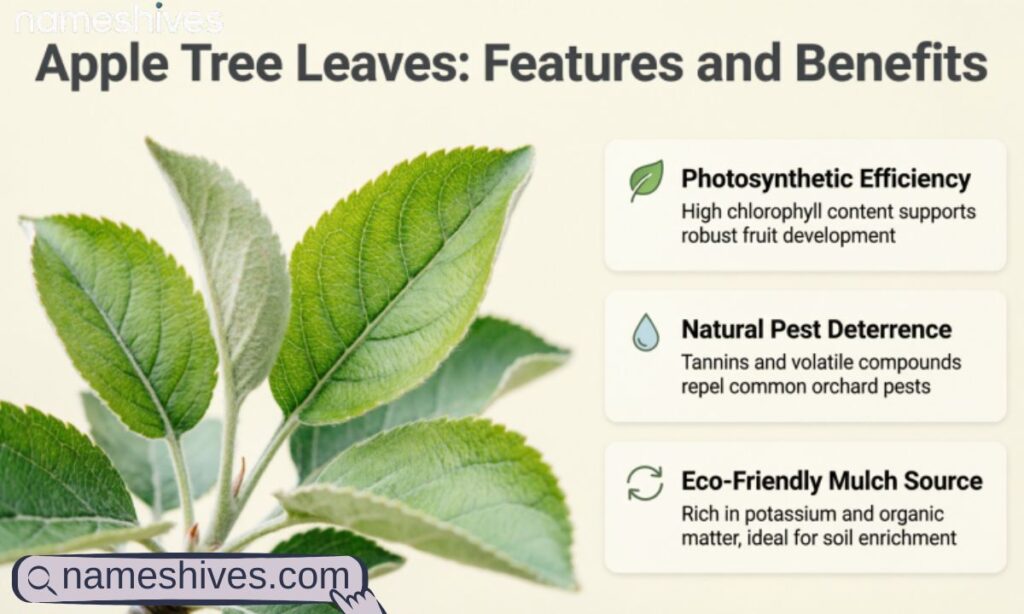
Physical Features:
- Shape: Oval to elliptical with a pointed tip and a finely serrated (toothed) edge
- Size: Typically 5–12 cm (2–5 inches) long
- Color: Dark green on top, pale and slightly hairy (pubescent) on the underside
- Arrangement: Alternately arranged along the stem
- Texture: Slightly leathery with a visible central vein
Ecological & Practical Benefits:
- Photosynthesis powerhouse — the broad surface area maximizes energy capture for fruit production
- Pest indicators — leaf curl, spots, or discoloration are early warning signs of diseases like apple scab or fire blight
- Wildlife habitat — leaves shelter insects and caterpillars, supporting biodiversity
- Compost value — fallen leaves break down into nutrient-rich organic matter for soil
- Traditional medicine — apple leaves have historically been used in folk remedies for fever and inflammation, containing compounds like quercetin and chlorogenic acid
Fruit of the Apple Tree
The apple fruit is botanically classified as a pome — a type of fleshy accessory fruit where the edible part develops not from the ovary alone, but from the enlarged floral receptacle surrounding it.
| Feature | Detail |
| Shape | Round to oblate or conical |
| Size | 5–10 cm in diameter (cultivated) |
| Skin colors | Red, green, yellow, or bi-colored |
| Flesh | Crisp, white to cream-colored |
| Seeds | 5–10 seeds in a central core |
| Taste | Sweet to tart depending on variety |
| Harvest season | Late summer through autumn |
Varieties and Types of Apple Trees
There are over 7,500 known cultivars of apple trees worldwide, each bred for specific traits like flavor, texture, disease resistance, or climate tolerance. They fall into three broad use categories:
Dessert (Eating) Apples:
- Fuji — exceptionally sweet, originally from Japan, one of the world’s most popular
- Gala — mild and sweet, excellent for snacking, ripens early
- Honeycrisp — famous for its explosive crunch and balanced sweet-tart flavor
- Red Delicious — classic American variety, deep red skin, mild flavor
- Pink Lady (Cripps Pink) — firm, tangy-sweet, long shelf life
Culinary (Cooking) Apples:
- Granny Smith — bright green, tart, holds shape well when baked
- Bramley — the premier British cooking apple, highly acidic and fluffy when cooked
- Cortland — slow to brown after cutting, ideal for salads and pies
Cider Apples:
- Dabinett — bitter-sweet English cider variety
- Kingston Black — considered the finest single-variety cider apple
- Yarlington Mill — classic West Country cider apple, rich and tannic
Lifespan, Size, and Growth of Apple Trees
| Tree Type | Height | Spread | Years to Fruit |
| Standard | 7–12 m (20–40 ft) | 9–12 m | 4–8 years |
| Semi-dwarf | 3–5 m (10–16 ft) | 3–5 m | 3–5 years |
| Dwarf | 1.5–3 m (5–10 ft) | 1.5–3 m | 2–3 years |
Growth Rate & Lifespan:
- Apple trees grow at a moderate rate of roughly 30–60 cm (12–24 inches) per year under good conditions
- Standard trees in the wild or in heritage orchards can live for 100–200 years, with some specimens recorded beyond that
- Commercially managed orchard trees are typically replaced after 20–40 years as productivity declines
- Trees require a period of winter chilling (cold dormancy) to produce fruit reliably the following season — typically 500–1,000 “chill hours” below 7°C (45°F)
- Most varieties are not self-fertile and require a second compatible cultivar nearby for cross-pollination
Native Region and Habitat of Apple
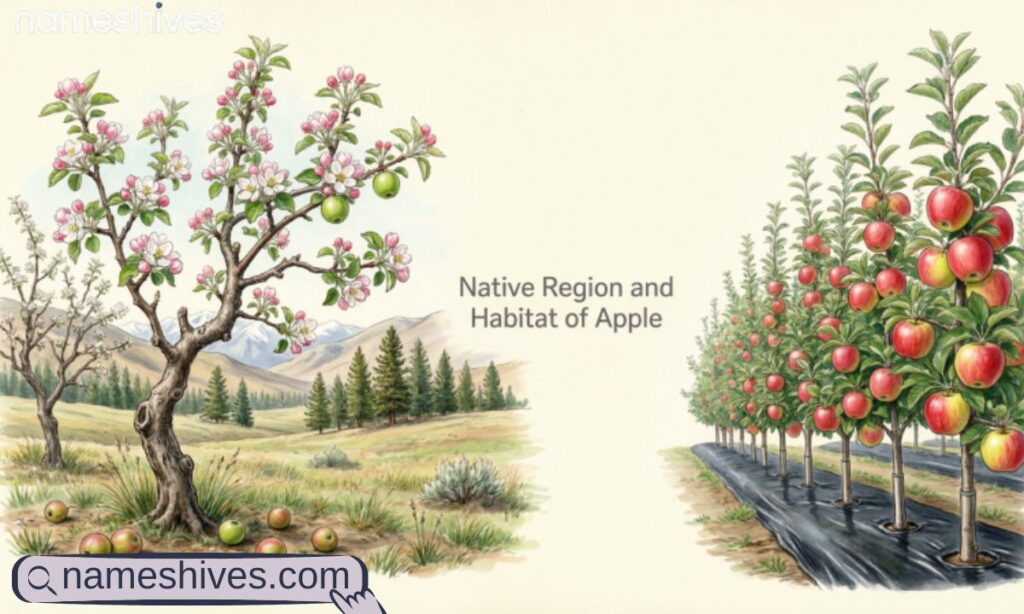
The cultivated apple (Malus domestica) traces its origins to Central Asia, specifically the wild forests of the Tian Shan mountain range in modern-day Kazakhstan, Kyrgyzstan, and northwestern China. Its primary wild ancestor is Malus sieversii, still found growing in those mountain forests today.
- Wild apples traveled westward along the Silk Road, crossing Persia, the Middle East, and into Europe
- Ancient Greeks and Romans actively cultivated and grafted apple varieties, accelerating domestication
- European colonists brought apples to North America, South America, South Africa, and Australia from the 17th century onward
- Today apples are grown on every inhabited continent, making them one of the most globally distributed fruits
Natural Habitat Preferences:
| Factor | Ideal Condition |
| Climate | Temperate, four-season |
| Temperature | −40°C to 35°C (tolerates frost) |
| Soil | Well-drained loamy soil, pH 6.0–7.0 |
| Sunlight | Full sun (minimum 6–8 hours/day) |
| Altitude | Up to 2,700 m in mountain regions |
| Rainfall | 600–1,200 mm annually |
Health Benefits of Apple Trees
The saying “an apple a day keeps the doctor away” has genuine scientific backing. Nearly every part of the apple tree — fruit, bark, leaves, and seeds — offers compounds with therapeutic value.
| Health Area | How Apples Help |
| Heart Health | Soluble fiber (pectin) lowers LDL cholesterol; flavonoids reduce blood pressure |
| Blood Sugar | Polyphenols slow carbohydrate digestion, improving insulin sensitivity |
| Gut Health | Pectin acts as a prebiotic, feeding beneficial gut bacteria |
| Cancer Prevention | Quercetin and catechins have shown anti-tumor properties in studies |
| Brain Health | Quercetin protects neurons from oxidative stress, linked to lower Alzheimer’s risk |
| Weight Management | High fiber and water content promotes satiety with low caloric density |
| Bone Health | Phloridzin, unique to apples, may improve bone density in women |
| Lung Health | Regular apple consumption linked to reduced asthma risk and better lung function |
| Immune Support | Vitamin C and antioxidants strengthen immune response |
Non-culinary uses of the apple tree
- Applewood is dense, fine-grained, and hard — prized by woodworkers for carving, turning, and tool handles
- Its beautiful reddish-brown color makes it ideal for decorative furniture, musical instruments, and wooden utensils
- Because it burns slowly and produces fragrant, mild smoke, applewood is one of the most sought-after woods for smoking meats and fish (BBQ smoking chips)
- Traditional uses include mallet heads, walking sticks, and wooden gears in old mills
Cosmetics & Skincare:
- Apple stem cell extracts are used in anti-aging creams and serums — particularly from the Swiss Uttwiler Spätlauber variety, known for its longevity
- Apple pectin is an ingredient in hair conditioners and face masks for moisture retention
- Apple cider vinegar is used as a skin toner and scalp treatment
Agriculture & Environment:
- Apple orchards provide critical pollinator habitat — a single orchard in bloom supports thousands of bees and other insects
- Tree roots help prevent soil erosion on hillsides and slopes
- Fallen apple leaves and fruit contribute to composting and soil enrichment
- Crabapple varieties (Malus sylvestris) are widely planted as ornamental trees in parks and gardens for their spring blossom display
Cultural & Symbolic Uses:
- Apple wood was traditionally used to carve religious figures and talismans in Celtic and Norse cultures
- The tree holds deep mythological significance — from the Garden of Eden to Norse mythology’s golden apples of Iðunn granting immortality
- Apple blossom is the official state flower of Michigan (USA) and Arkansas
Apple Tree Life Cycle
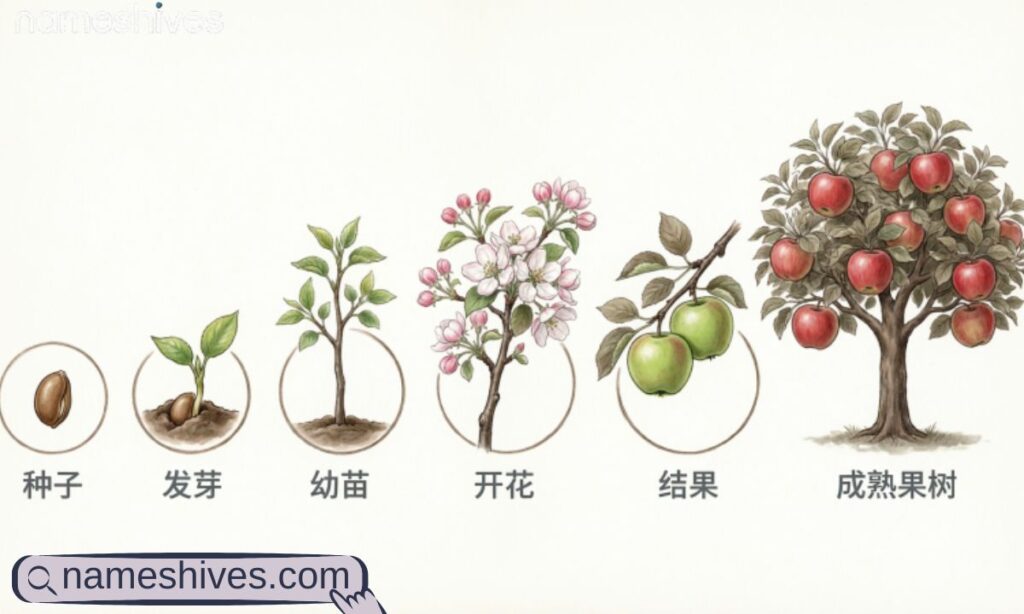
Winter — Dormancy
- The tree enters full dormancy to survive freezing temperatures
- All energy is conserved in the roots and woody tissue
- Buds remain tightly closed and protected by bud scales
- Accumulating chill hours (cold exposure) is essential — without enough cold, the tree won’t bloom properly in spring
- Farmers prune during this period to shape growth and remove diseased wood
Early Spring — Bud Break & Bloom
- Rising temperatures trigger bud swell, then bud break
- Leaves unfurl first, followed by the spectacular blossom stage — clusters of white and pink flowers open
- This is the most critical and vulnerable period — a late frost can destroy the entire year’s crop
- Pollination occurs here: bees and other insects transfer pollen between flowers (cross-pollination between two compatible varieties is essential for most cultivars)
- Each successfully pollinated flower will become one apple
Late Spring — Fruit Set
- Fertilized flowers shed their petals and the ovary begins swelling into a tiny fruitlet
- The tree naturally drops excess fruitlets in a process called “June drop” — a self-thinning mechanism to concentrate energy
- Farmers also hand-thin fruitlets to improve size and quality of remaining apples
Summer — Fruit Development
- The fruitlets grow steadily, accumulating sugars, starches, and water
- Leaves photosynthesize vigorously, channeling energy into the developing fruit
- Color development begins in late summer as chlorophyll breaks down
- This stage requires adequate sunlight, irrigation, and pest management
Autumn — Harvest & Ripening
- Fruit reaches full maturity — sugars peak, starches convert, and the apple separates easily from the branch
- Harvest windows vary by variety: Gala ripens in August–September, Fuji and Granny Smith in October–November
- After harvest, leaves begin to change color and fall as the tree prepares for dormancy again
- The tree stores carbohydrate reserves in its roots for the following year’s growth
Apple Tree Names in Different Languages
The apple’s global journey over millennia is reflected in its rich diversity of names across languages and cultures:
| Language | Word for Apple | Pronunciation Guide |
| English | Apple | AP-ul |
| Latin | Malus / Pomum | MAH-lus / POH-mum |
| French | Pomme | Pom |
| Spanish | Manzana | Man-ZAH-nah |
| Portuguese | Maçã | Mah-SAHN |
| Italian | Mela | MEH-lah |
| German | Apfel | AP-fel |
| Dutch | Appel | AH-pel |
| Russian | Яблоко (Yabloko) | YAH-bloh-koh |
| Arabic | تفاحة (Tuffaha) | Too-FAH-hah |
| Urdu/Hindi | سیب / सेब (Seb) | Seb |
| Mandarin Chinese | 苹果 (Píngguǒ) | Ping-gwoh |
| Japanese | リンゴ (Ringo) | Reen-go |
| Korean | 사과 (Sagwa) | Sah-gwah |
| Turkish | Elma | EL-mah |
| Persian (Farsi) | سیب (Sib) | Seeb |
| Hebrew | תפוח (Tapuach) | Tah-POO-akh |
| Greek | Μήλο (Milo) | MEE-loh |
| Swahili | Tofaa | Toh-FAH |
| Welsh | Afal | AH-val |
| Irish (Gaelic) | Úll | Ool |
How many varieties of apples are there?
The numbers are staggering. There are estimated to be over 7,500 named cultivars of apples worldwide — and some botanical records push that figure closer to 10,000 when including regional, heritage, and unofficial varieties.
| Category | Count |
| Named cultivars globally | 7,500–10,000 |
| Varieties in the UK alone | 2,000+ |
| Varieties in the USA | 2,500+ |
| Varieties commercially grown today | ~100 |
| Varieties in most supermarkets | 10–15 |
What types of apple trees should you plant?
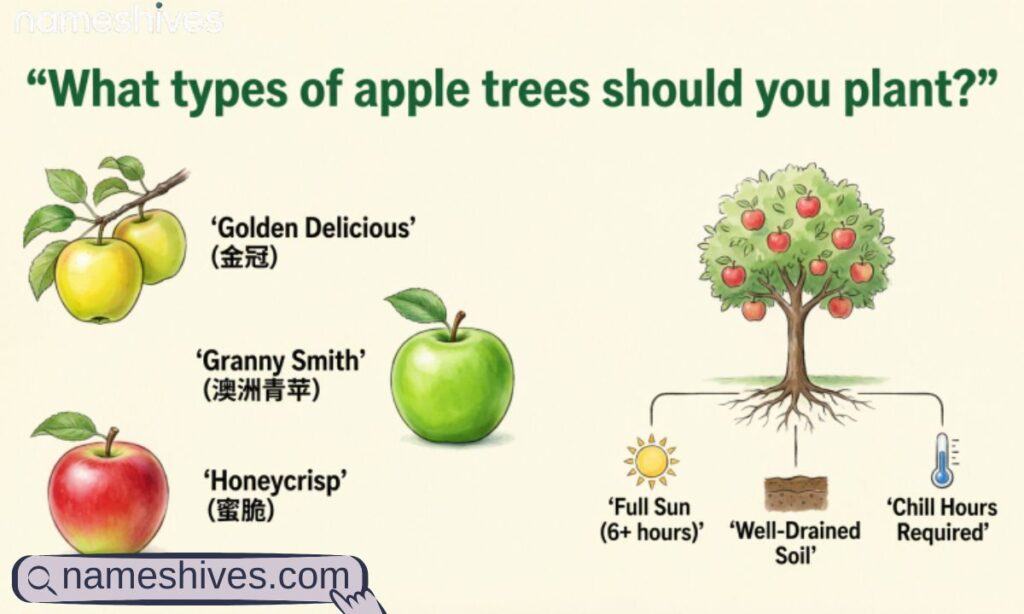
Step 1 — Know Your Climate Zone
Apple trees need chill hours (hours below 7°C/45°F in winter) to break dormancy and fruit properly. Matching a variety to your climate is the single most important decision.
| Climate Type | Recommended Varieties |
| Cold climates (long winters) | Honeycrisp, McIntosh, Haralson, Zestar |
| Temperate (moderate winters) | Gala, Fuji, Golden Delicious, Braeburn |
| Warm/mild winters | Anna, Dorsett Golden, Tropic Sweet |
| Hot & humid | Anna, Ein Shemer, Pettingill |
| High altitude | Cox’s Orange Pippin, Bramley, Discovery |
Low-Chill Varieties (under 400 chill hours) are essential for warm climates like those in Pakistan, India, and the Middle East — Anna and Dorsett Golden are the most reliable choices for such regions.
Frequently Asked Questions
What is the scientific name of the apple tree?
The scientific name of the apple tree is Malus domestica. It belongs to the genus Malus and the family Rosaceae.
Which genus does the apple tree belong to?
The apple tree belongs to the genus Malus. This genus includes many species of apple and crabapple trees.
What are the common types of apple trees?
Common types include Fuji, Gala, Red Delicious, Golden Delicious, and Granny Smith. Each type has a different taste, color, and texture.
What are the main uses of apple trees?
Apple trees are mainly grown for their fruits. Apples are used for eating fresh, making juice, pies, jams, and cider.
What are the health benefits of apples?
Apples are rich in fiber, vitamins, and antioxidants. They help support heart health, digestion, and overall wellness.
Where do apple trees grow best?
Apple trees grow best in temperate climates with cool winters and moderate summers. They need plenty of sunlight and well-drained soil.
How long does an apple tree take to produce fruit?
Most apple trees start producing fruit in about 3 to 5 years. The exact time depends on the variety and growing conditions.
What is the classification of the apple tree?
The apple tree is classified under Kingdom Plantae, Family Rosaceae, Genus Malus, and Species Malus domestica.
Why are apple trees important in agriculture?
Apple trees are important because apples are one of the most widely grown fruits in the world. They provide food and income for farmers.
How many types of apples exist worldwide?
There are more than 7,500 types of apples grown around the world. Each variety differs in taste, size, and color.
Conclusion
In conclusion, the apple tree, known by its scientific name Malus domestica, is one of the most popular fruit trees in the world. It belongs to the genus Malus and includes many different types grown in various climates. Apples are loved for their sweet taste, bright colors, and nutritional value. Because of their wide variety, apple trees are grown in gardens, farms, and orchards across many countries.
Apple trees are not only important for their fruit but also for their many uses and health benefits. Apples can be eaten fresh, used in cooking, or made into juices and desserts. They provide vitamins, fiber, and antioxidants that support good health. Overall, the apple tree remains a valuable plant for both farmers and families, offering beauty, food, and nutrition.

David Corner is a names expert with 4 years of experience in researching name meanings, origins, and cultural significance. He is currently working with Nameshives.com, where he contributes to creating insightful and meaningful name content for a global audience.
