

The chicken is one of the most common and useful birds in the world. People raise it for eggs, meat, and even as a pet. Its scientific name helps us understand its true place in the animal kingdom. Learning about the chicken’s species and classification makes it easier to see how it is related to other birds.
The scientific name of the domestic chicken is Gallus gallus domesticus. It belongs to the same family as wild junglefowl. Through biological classification, we can trace its group, order, and family step by step. This simple system helps scientists study chickens more clearly and understand their origin and development.
What is the scientific name for a Hen?
The scientific name for a domestic hen (chicken) is Gallus gallus domesticus.
Scientific Classification of Chicken
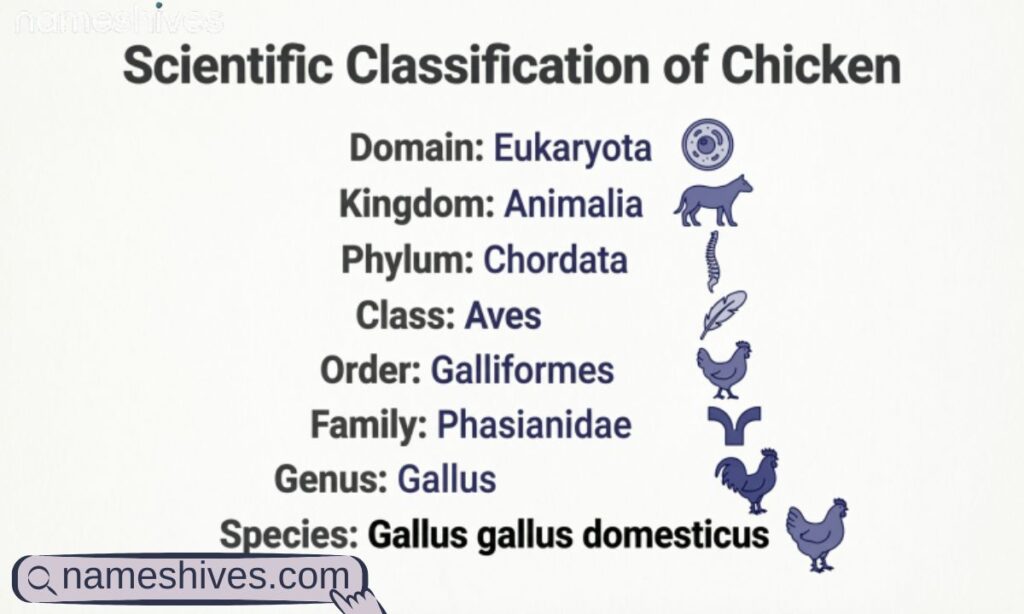
| Rank | Name |
| Kingdom | Animalia |
| Phylum | Chordata |
| Class | Aves |
| Order | Galliformes |
| Family | Phasianidae |
| Genus | Gallus |
| Species | Gallus gallus |
| Subspecies | Gallus gallus domesticus |
Species of Gallus (Chicken’s Genus)
- Red Junglefowl – Gallus gallus (the direct ancestor of domestic chickens)
- Grey Junglefowl – Gallus sonneratii
- Sri Lanka Junglefowl – Gallus lafayettii
- Green Junglefowl – Gallus varius
Understanding the Chicken’s Scientific Name
- Gallus – Latin for “rooster” or “cock”
- gallus (repeated) – Indicates it is the type species of the genus
- domesticus – Latin for “domesticated,” distinguishing it from its wild ancestor
Why Use Biological Names for Chicken?
- Universal Recognition – The scientific name is understood globally, regardless of language or region. A chicken may be called pollo, poulet, or Huhn — but Gallus gallus domesticus is universal.
- Avoids Confusion – Common names can refer to different animals in different regions. Scientific names are precise and unambiguous.
- Shows Evolutionary Relationships – The classification reveals how chickens are related to other birds and animals, helping in biological research.
- Essential for Science & Research – Veterinary medicine, genetics, and agricultural science rely on accurate scientific naming for studies and publications.
- Aids in Conservation – Proper classification helps identify and protect related wild species like the Red Junglefowl.
- Legal & Regulatory Purposes – International trade, food safety regulations, and wildlife laws often require precise scientific identification.
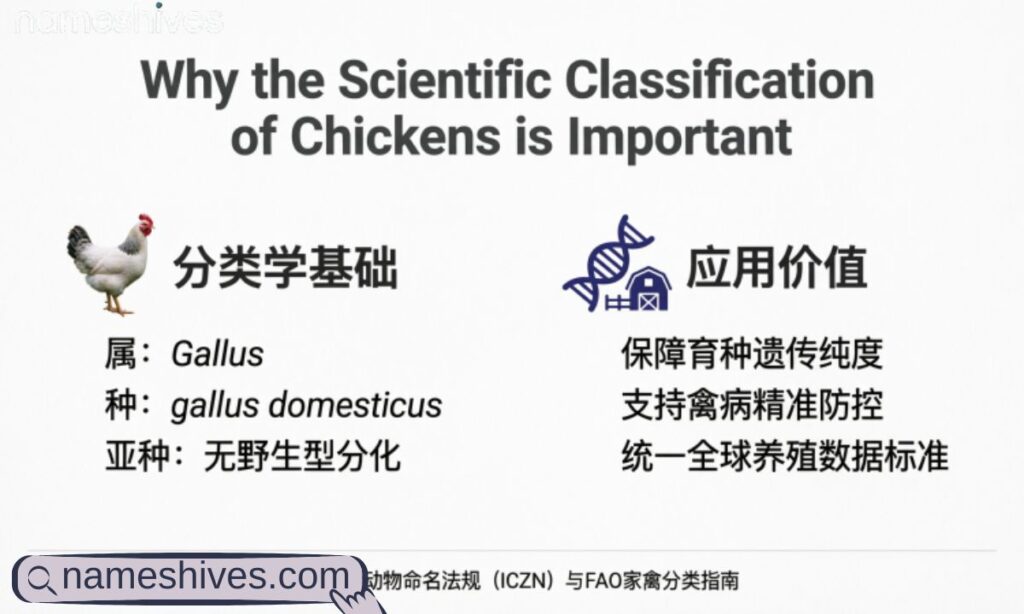
Why the Scientific Classification of Chickens is Important
Scientific Research
Classification helps researchers study genetics, diseases, and behavior systematically. Knowing that chickens belong to Gallus gallus domesticus allows scientists to trace genomic data accurately.
Global Communication
Scientists, farmers, and veterinarians worldwide use the same scientific name, eliminating confusion caused by regional common names.
Breeding & Agriculture
Understanding classification helps breeders develop better breeds for egg production, meat quality, and disease resistance.
Legal & Trade Purposes
International poultry trade, food safety laws, and import/export regulations require precise biological identification.
Conservation
Classification helps identify the wild relatives of domestic chickens (like the Red Junglefowl), supporting conservation efforts.
Veterinary Medicine
Accurate classification ensures the correct diagnosis and treatment of poultry diseases and helps develop targeted vaccines.
Most Common Breeds of Chickens
Egg-Laying Breeds
| Breed | Origin | Egg Color | Annual Eggs |
| Leghorn | Italy | White | 280–320 |
| Rhode Island Red | USA | Brown | 250–300 |
| Plymouth Rock | USA | Brown | 200–280 |
| Australorp | Australia | Brown | 250–300 |
| Ameraucana | USA | Blue/Green | 200–250 |
Meat Breeds
| Breed | Origin | Characteristics |
| Cornish Cross | UK/USA | Fast-growing, broad-breasted |
| Jersey Giant | USA | Largest chicken breed |
| Brahma | India/USA | Heavy, cold-hardy |
| Cochin | China | Fluffy feathers, large size |
Dual-Purpose Breeds (Eggs & Meat)
| Breed | Origin | Known For |
| Sussex | England | Calm temperament |
| Wyandotte | USA | Hardy in cold climates |
| Dominique | USA | Oldest American breed |
| Orpington | England | Gentle, good layer |
Ornamental/Fancy Breeds
- Silkie – Known for fluffy, silk-like feathers
- Polish – Recognized by its dramatic feathered crest
- Sebright – One of the oldest true bantam breeds
- Frizzle – Features uniquely curled feathers
Origin and Evolution of the Chicken Species
| Period | Event |
| ~6,000–8,000 BCE | First domestication of Red Junglefowl in Southeast Asia |
| ~4,000 BCE | Chickens spread to the Indus Valley (modern Pakistan/India) |
| ~1,400 BCE | Introduced to the Middle East and Egypt |
| ~800 BCE | Arrived in Greece and Europe |
| ~1500s CE | Brought to the Americas by Spanish explorers |
| 19th Century | Selective breeding begins producing distinct modern breeds |
| 20th Century | Industrial poultry farming revolutionizes global food supply |
Difference Between Wild Junglefowl and Domestic Chicken
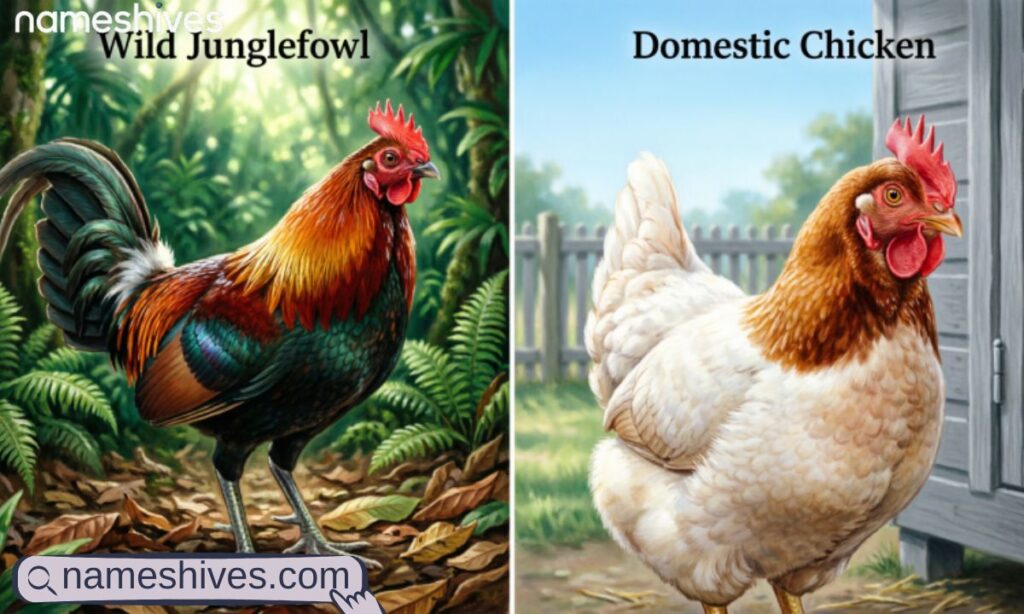
| Feature | Wild Red Junglefowl | Domestic Chicken |
| Scientific Name | Gallus gallus | Gallus gallus domesticus |
| Size | Smaller, leaner | Larger, heavier |
| Weight | 0.5–1.5 kg | 1.5–5+ kg (breed dependent) |
| Egg Production | ~12 eggs/year | Up to 320 eggs/year |
| Temperament | Wild, aggressive, alert | Generally calm and docile |
| Flight Ability | Strong flier | Weak, limited flight |
| Habitat | Forests of South/SE Asia | Worldwide, farms & backyards |
| Diet | Forages naturally | Fed commercial feed + forage |
| Lifespan | 5–10 years (wild) | 5–10 years (varies by breed) |
| Brooding | Naturally broods seasonally | Many breeds have lost brooding instinct |
| Plumage | Bright, colorful (males); camouflaged (females) | Highly varied depending on breed |
| Predator Awareness | Highly alert and evasive | Reduced survival instincts |
| Domestication Status | Wild species | Fully domesticated subspecies |
Frequently Asked Questions
What is the scientific name of a chicken?
The scientific name of a chicken is Gallus gallus domesticus, which shows it is a domesticated subspecies of the red junglefowl.
What species does a domestic chicken belong to?
Domestic chickens belong to the species Gallus gallus, the wild ancestor found in Southeast Asia.
What is the biological classification of a hen?
A hen is classified under Kingdom Animalia, Phylum Chordata, Class Aves, Order Galliformes, Family Phasianidae, Genus Gallus.
Is a hen different from a chicken in scientific terms?
No, a hen is simply an adult female chicken; both share the same scientific name and species classification.
What family do chickens belong to?
Chickens belong to the family Phasianidae, which also includes pheasants, quails, and turkeys.
What is the genus of the domestic chicken?
The genus of the domestic chicken is Gallus, which groups it with junglefowl species.
Are chickens birds or mammals?
Chickens are birds and belong to the class Aves, not mammals.
Where did domestic chickens originally come from?
Domestic chickens descended from the red junglefowl native to parts of Asia.
What order do chickens belong to in classification?
Chickens belong to the order Galliformes, a group of ground-feeding birds.
Why is the scientific name of chicken important?
The scientific name helps scientists identify chickens clearly worldwide and avoid confusion with local names.
Conclusion
The scientific name of the chicken is Gallus gallus domesticus, and it belongs to the same family as the wild red junglefowl. Chickens are part of the species Gallus gallus, which shows their natural origin. They are classified under the class Aves, meaning they are birds. This biological classification helps us understand their place in the animal kingdom.
Hens are female chickens, but they share the same scientific classification as roosters. Knowing the chicken’s scientific name makes it easier to study, protect, and manage them properly. It also helps farmers and scientists communicate clearly around the world. In simple words, biological classification gives us a clear picture of where chickens belong in nature.

David Corner is a names expert with 4 years of experience in researching name meanings, origins, and cultural significance. He is currently working with Nameshives.com, where he contributes to creating insightful and meaningful name content for a global audience.
